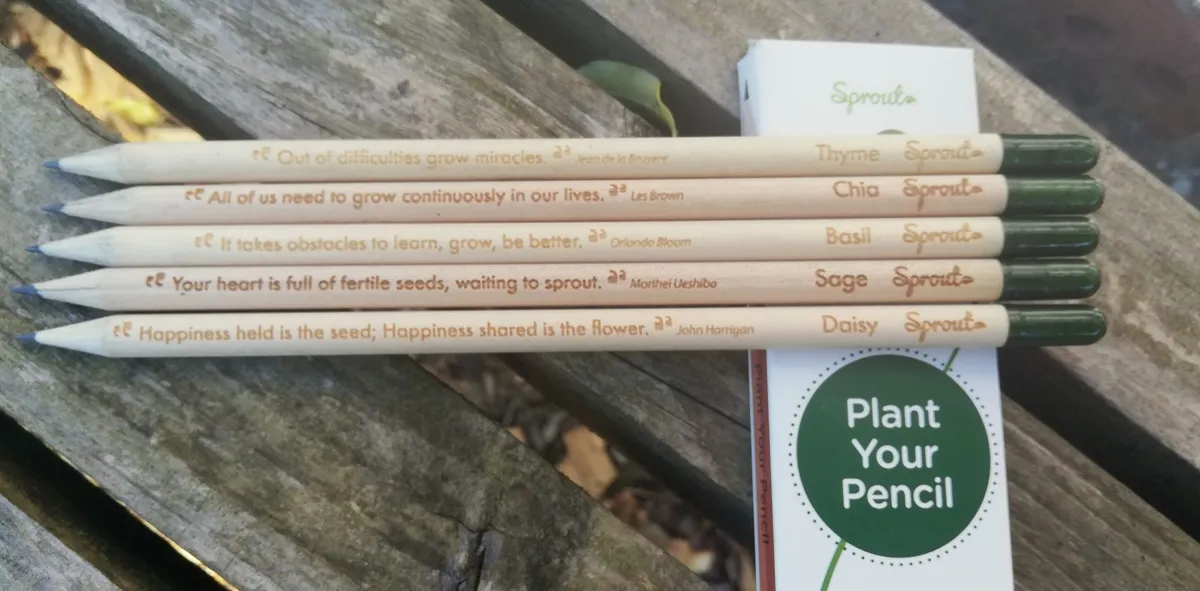
From Trash to Tomatoes: The $16 Pencil That Grows Into Plants (and a Viral Green Business)
You’ve probably thrown away hundreds of pencils in your life.
Now imagine this: instead of ending up in the trash, that same pencil could grow into a tomato plant, a strawberry bush, or even a sunflower.
Sounds like a gimmick, right?
It’s not.
A simple “plantable pencil” from Sprout World has turned this idea into a global business—one that consumers are happily paying a 200% premium for.
A Pencil That Doesn’t Die—It Grows
Here’s how it works.
At the end of each pencil sits a tiny, biodegradable capsule filled with seeds. Once the pencil becomes too short to use, you plant it in soil, add water, and within days, the capsule dissolves. The seeds begin to sprout, transforming what would’ve been waste into something alive.
We’re talking about basil, chili peppers, strawberries, wildflowers—even trees.
It’s not magic. It’s just smart design.
The MIT Idea That Almost Failed
The concept was originally developed by three students from Massachusetts Institute of Technology. They were struck by a simple but massive problem:
Every year, around 15 billion pencils are produced globally.
A huge portion ends up as discarded stubs—completely useless waste.
So they asked a better question:
What if a pencil didn’t end its life when it became unusable?
That question became a product.
They designed a pencil made from FSC-certified cedar wood, a graphite-and-clay core (no actual lead), and a seed capsule at the end—turning a disposable object into a regenerative one.
The idea was eventually acquired by a Danish entrepreneur, who turned it into a brand: Sprout World.
But here’s the twist—it didn’t take off immediately.
The TikTok Moment That Changed Everything
For years, Sprout struggled with average sales.
Then in 2022, everything changed.
They posted a short video on TikTok showing a used pencil being planted and growing into a plant.
That single piece of content exploded—millions of views, massive engagement, and a surge in demand that caused the brand to sell out multiple times.
Within just a few weeks:
- Hundreds of thousands of new followers
- Tens of millions of impressions
- Website traffic spikes
- Repeated stock shortages
It wasn’t just a viral moment.
It was product-market fit meeting the algorithm.
Why People Pay 200% More for This Pencil
Let’s be honest—this is still a pencil.
So why are people paying $16 for an 8-pack?
Three reasons drive everything:
1. Sustainability Isn’t Optional Anymore
In Western markets, sustainability is no longer a “nice-to-have”—it’s expected.
Sprout doesn’t just sell an eco-friendly product. It builds an entire narrative around environmental responsibility. The company has even invested in reforestation efforts, planting thousands of trees to reinforce its mission.
Consumers notice that.
Studies show that 78% of Western consumers expect brands to take responsibility for climate action. If your product aligns with that expectation, you’re not just selling—you’re qualifying for the market.
2. Built-In Differentiation
There are thousands of pencil brands.
There is only one that turns into a plant.
That alone creates a powerful competitive moat.
But Sprout goes further:
- Custom engraving on each pencil
- Personalized packaging
- Gift-ready product design
This taps directly into the Western consumer desire for individuality and self-expression.
You’re not buying stationery.
You’re buying identity.
3. The “Giftable” Effect
This might be the most underrated growth driver.
Sprout transformed a simple pencil into a social object—something you give, share, and post about.
They created themed sets, expanded into plantable makeup (like eyeliner and brow pencils), and even developed sustainable notebooks.
More importantly, they entered the corporate gifting space:
- Brands like IKEA
- And Disney
These companies use plantable pencils as eco-friendly promotional gifts—replacing traditional, disposable merchandise at scale.
That’s not just a product.
That’s a system.
The Real Takeaway: A Formula for Global Growth
Sprout World didn’t just create a clever product.
It built a replicable growth model:
Sustainability + Self-Expression + Contextual Use Cases
- Sustainability gets you in the door
- Differentiation lets you charge more
- Giftability drives viral distribution
Add social media—and especially creator-driven platforms like TikTok—and you get exponential reach.
Final Thought
The most interesting part of this story isn’t the pencil.
It’s the mindset shift.
Turning a disposable object into something regenerative isn’t just good design—it’s good business.
And in a world where consumers are increasingly voting with their wallets, the brands that win won’t just sell products.
They’ll sell purpose—one pencil at a time.
