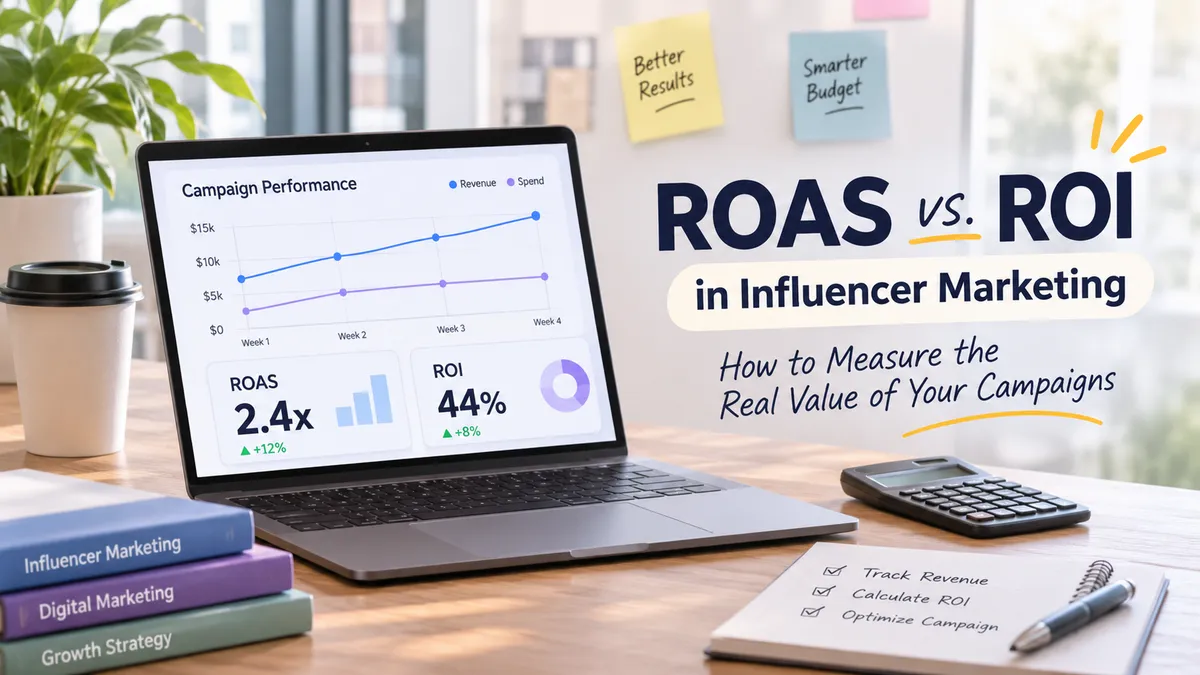
ROAS vs. ROI in Influencer Marketing: How to Measure the Real Value of Your Campaigns
Introduction
Is your influencer marketing campaign actually making money, or is it simply generating impressive sales numbers?
For brands investing in creators, this is an important distinction. A campaign might generate thousands of dollars in attributed revenue, but once creator fees, product costs, shipping, and advertising expenses are included, the actual profit could look very different.
This is where two essential marketing metrics come into play: Return on Ad Spend (ROAS) and Return on Investment (ROI).
Although marketers sometimes use these terms interchangeably, they measure different aspects of campaign performance. ROAS focuses on the revenue generated relative to marketing spend, while ROI considers whether the overall investment produces a profit.
Understanding both metrics helps brands evaluate influencer partnerships, allocate budgets more effectively, and identify which creators are genuinely contributing to business growth.
In this guide, we'll explain the difference between ROAS and ROI, walk through practical calculation examples, and explore how brands can use these metrics to build more profitable influencer marketing campaigns.
ROAS vs. ROI: What's the Difference?
ROAS and ROI both measure marketing performance, but they answer different questions.
ROAS: How much revenue does your campaign generate for every dollar spent?
ROI: How much profit does your campaign generate after accounting for the costs involved?
Let's break down each metric.
What Is ROAS (Return on Ad Spend)?
Return on Ad Spend measures the revenue generated for every dollar invested in advertising or a marketing campaign.
It is particularly useful for evaluating paid influencer collaborations, affiliate campaigns, and creator content promoted through paid social advertising.
ROAS Formula:
ROAS = Attributed Revenue ÷ Campaign Spend
For example, if a brand spends $5,000 on an influencer campaign and generates $12,000 in attributed revenue:
ROAS = $12,000 ÷ $5,000 = 2.4x
This means the campaign generates $2.40 in revenue for every $1 invested.
A higher ROAS generally indicates more efficient revenue generation. However, it does not automatically mean the campaign is profitable because it does not account for the cost of producing and fulfilling the products.
What Is ROI (Return on Investment)?
Return on Investment measures the profitability of an investment after accounting for its associated costs.
Unlike ROAS, ROI considers the actual profit remaining after expenses are deducted.
ROI Formula:
ROI = (Net Profit ÷ Total Investment) × 100%
For influencer marketing, a more useful campaign-level calculation is:
ROI = [(Revenue × Gross Margin − Campaign Costs) ÷ Campaign Costs] × 100%
For example, if a campaign generates $12,000 in revenue, has a 60% gross margin, and costs $5,000:
Revenue: $12,000
Gross profit: $7,200
Campaign costs: $5,000
Net campaign profit: $2,200
ROI = ($2,200 ÷ $5,000) × 100% = 44%
The campaign generates a 44% return after accounting for product costs and campaign expenses.
This is why looking at revenue alone can give marketers an incomplete picture of campaign success.
ROAS vs. ROI: A Side-by-Side Comparison
Measurement | ROAS | ROI |
|---|---|---|
Full name | Return on Ad Spend | Return on Investment |
Main focus | Revenue generation | Profitability |
Formula | Revenue ÷ Spend | Net Profit ÷ Investment |
Considers product costs | No | Yes, when included |
Typical format | 2.4x or 240% | 44% |
Best used for | Comparing campaign revenue efficiency | Evaluating overall financial returns |
Both metrics are important. ROAS helps marketers understand how efficiently a campaign generates sales, while ROI helps business owners determine whether that campaign is worth the investment.
How to Calculate ROAS and ROI for an Influencer Marketing Campaign
Understanding the formulas is only the first step. To evaluate an actual influencer campaign, brands need to account for all relevant expenses and accurately measure the revenue generated.
Let's walk through a practical example.
Step 1: Calculate the Total Campaign Cost
Imagine an e-commerce brand launches a campaign with five TikTok creators to promote a new product.
Each creator publishes sponsored content, and the brand also invests in paid advertising to amplify the best-performing videos.
Here is how the campaign budget looks:
Expense | Cost |
|---|---|
Creator fees (5 × $500) | $2,500 |
Product samples and shipping | $500 |
Content usage rights | $300 |
Paid advertising | $1,700 |
Total campaign cost | $5,000 |
One common mistake brands make is calculating campaign returns using creator fees alone.
In reality, influencer marketing involves several additional expenses. Product samples, shipping, content licensing, agency fees, and paid amplification can all affect the final result.
For more guidance on evaluating creator pricing before committing to a campaign, check out SocialBook's guide to collaborating with micro-influencers.
Step 2: Track Influencer-Generated Revenue
After the campaign goes live, the brand needs to understand how much revenue each creator generates.
Several tracking methods can help:
Unique Discount Codes
Give each influencer a personalized discount code. When customers use that code during checkout, brands can identify the purchases associated with that creator.
Affiliate and Tracking Links
Provide creators with unique URLs that direct their audiences to the product page. These links help track clicks, conversions, and attributed sales.
UTM Parameters
Add UTM parameters to campaign links so that website analytics platforms can identify traffic sources, campaign names, and creator-specific performance.
Post-Purchase Surveys
Ask customers how they discovered the brand. This can help identify influencer-driven purchases that traditional tracking links or discount codes might miss.
For example, the campaign generates the following results:
Creator | Attributed Orders | Revenue |
|---|---|---|
Creator A | 40 | $4,000 |
Creator B | 25 | $2,500 |
Creator C | 20 | $2,000 |
Creator D | 20 | $2,000 |
Creator E | 15 | $1,500 |
Total | 120 | $12,000 |
The campaign generates $12,000 in attributed revenue from 120 orders.
One important rule: avoid counting the same order twice. If a customer clicks an influencer's tracking link and later uses the same influencer's discount code, the purchase should only be counted once.
Step 3: Calculate ROAS and ROI
Now that we know the campaign's total cost and attributed revenue, we can calculate both metrics.
Assume the brand has a 60% gross margin.
Metric | Calculation | Result |
|---|---|---|
Total revenue | — | $12,000 |
Campaign cost | — | $5,000 |
ROAS | $12,000 ÷ $5,000 | 2.4x |
Gross profit | $12,000 × 60% | $7,200 |
Net campaign profit | $7,200 − $5,000 | $2,200 |
ROI | $2,200 ÷ $5,000 × 100% | 44% |
The campaign generates a 2.4x ROAS and a 44% ROI.
At first glance, the $12,000 in revenue looks impressive. But the ROI calculation provides a more realistic understanding of the financial return.
This is why brands should evaluate both metrics rather than relying on revenue or ROAS alone.
Which Influencers Actually Deliver the Best ROI?
A campaign's overall performance does not tell the whole story.
Some creators might generate substantial revenue, while others contribute more to brand awareness, engagement, or customer acquisition.
If brands only evaluate the campaign as a whole, they may overlook the creators responsible for the strongest results.
Consider the following example:
Creator | Campaign Cost | Revenue | ROAS |
|---|---|---|---|
Creator A | $1,000 | $4,000 | 4.0x |
Creator B | $1,000 | $2,500 | 2.5x |
Creator C | $1,000 | $2,000 | 2.0x |
Creator D | $1,000 | $2,000 | 2.0x |
Creator E | $1,000 | $1,500 | 1.5x |
Creator A delivers the highest ROAS, while Creator E generates the lowest revenue relative to campaign cost.
However, brands should not automatically discontinue every creator with a lower ROAS.
For example, Creator E might have introduced the brand to a new audience segment, generated strong engagement, or produced content that the brand can reuse in future advertising campaigns.
A better approach is to evaluate each creator based on the campaign objective.
For sales-driven campaigns, prioritize conversions, revenue, CPA, and ROI. For awareness campaigns, consider reach, impressions, engagement, and CPM.
Brands looking to evaluate creators more accurately should also understand the broader metrics behind influencer performance. SocialBook's guide to analyzing influencer metrics explains how to assess audience quality, engagement, reach, and conversion performance.
What Is a Good ROAS for Influencer Marketing?
There is no universal ROAS benchmark that guarantees a successful influencer campaign.
The right target depends on several factors, including:
Product profit margins.
Average order value.
Customer acquisition costs.
Creator fees and collaboration expenses.
Advertising and distribution costs.
Whether the campaign focuses on immediate sales or long-term brand growth.
One useful way to determine your minimum ROAS is to calculate your break-even point.
Break-Even ROAS Formula:
Break-Even ROAS = 1 ÷ Gross Margin
For example:
Gross Margin | Break-Even ROAS |
|---|---|
30% | 3.33x |
40% | 2.50x |
50% | 2.00x |
60% | 1.67x |
70% | 1.43x |
If your brand has a 60% gross margin, you need approximately 1.67x ROAS to cover the campaign investment and product costs under this simplified model.
A campaign generating 1.5x ROAS would not break even, while one generating 2.5x ROAS would generate a positive return before any additional costs not included in the calculation.
Keep in mind that this calculation assumes the campaign spend includes all relevant marketing costs and that the gross margin accounts for product and fulfillment costs. Additional overhead, taxes, or other expenses may increase the actual profitability threshold.
4 Common Mistakes Brands Make When Measuring Influencer Marketing ROI
Even experienced marketers can make mistakes when evaluating influencer campaign performance. Here are four common issues to avoid.
1. Focusing Only on Revenue
High revenue does not necessarily mean high profitability.
A campaign can generate significant sales but still deliver a negative ROI if creator fees, product costs, and advertising expenses are too high.
Always consider profit margins when evaluating campaign performance.
2. Ignoring Influencer Content Performance
Not every influencer collaboration is designed to generate immediate purchases.
Some creators produce content that builds brand awareness, increases audience trust, or introduces products to new customer segments.
These results may influence future conversions even if they do not appear in immediate sales reports.
Keep engagement, reach, and content performance separate from direct revenue measurements.
3. Using Inconsistent Attribution Methods
Tracking links, discount codes, and last-click attribution can produce different results.
For example, someone might discover a product through TikTok, revisit the website through Google, and complete the purchase several days later.
If the brand only uses last-click attribution, the influencer's contribution may be overlooked.
Use consistent attribution windows and combine multiple tracking methods where possible.
4. Evaluating Every Creator Using the Same Standard
A creator focused on lifestyle storytelling may not generate the same immediate conversions as a product-review creator.
That does not automatically make one less valuable.
Set clear objectives before launching a campaign and evaluate creators using metrics that align with their roles.
How SocialBook Helps Brands Make More Data-Driven Influencer Marketing Decisions
Measuring ROAS and ROI is important, but achieving better results starts long before a campaign goes live.
Brands need to identify suitable creators, understand their audiences, evaluate their content performance, and build partnerships that align with business goals.
This is where SocialBook can help.
SocialBook provides influencer discovery and analytics tools that help brands and agencies make more informed creator selection decisions.
1. Discover Influencers Who Match Your Target Audience
Search for creators across major social platforms using relevant filters, including niche, audience characteristics, location, and follower size.
Instead of choosing influencers based solely on popularity, brands can narrow down their search to creators who better match their target customers.
2. Evaluate Creator Performance Before Collaboration
Review important creator information, including audience demographics, engagement, follower growth, and content performance.
These insights help brands identify potential red flags and compare creators before committing to collaboration budgets.
3. Compare Creators and Build a More Effective Shortlist
A successful campaign often depends on selecting the right combination of creators rather than spending the entire budget on one large influencer.
Use creator research and performance insights to compare potential partners and prioritize those who fit your campaign goals.
4. Make Smarter Campaign Decisions
After evaluating campaign results, brands can use performance data to identify successful creator partnerships, refine their selection criteria, and improve future marketing strategies.
Whether your goal is to increase brand awareness, drive e-commerce sales, or scale an affiliate program, a data-driven approach makes it easier to understand where your marketing budget is going.
Explore SocialBook's influencer search platform to discover creators and make more informed influencer marketing decisions.
Final Thoughts: ROAS Shows Revenue Efficiency, ROI Reveals Profitability
ROAS and ROI are two essential metrics for understanding influencer marketing performance, but neither should be viewed in isolation.
ROAS tells you how much revenue your campaign generates relative to its costs. ROI tells you whether the investment produces actual profit after accounting for the expenses included in your calculation.
For brands looking to scale influencer marketing, the goal should not simply be to generate more attributed sales. It should be to build a repeatable strategy that consistently connects the right creators with the right audiences while maintaining healthy profit margins.
Start by defining campaign objectives, tracking every relevant expense, measuring creator-level performance, and reviewing the results after each collaboration.
With a consistent measurement framework and the right influencer analytics tools, brands can move beyond vanity metrics and make smarter decisions about where to invest their next marketing dollar.
Ready to find the right influencers for your next campaign? Explore SocialBook and start building a more data-driven influencer marketing strategy.
