AI Search Is Changing Influencer Marketing: How Brands Can Get Discovered by ChatGPT and Beyond
AI search is changing how consumers discover products.
Instead of typing a few keywords into Google and browsing through pages of results, shoppers can now ask ChatGPT, Gemini, or Perplexity for personalized recommendations. They can describe their budget, preferences, lifestyle, and specific needs, then receive a shortlist of products that fit.
For brands, this creates a new challenge: How do you get recommended when customers ask AI what to buy?
Traditional SEO helps brands appear in search results. Influencer marketing helps brands build trust and generate conversations. Now, these two strategies increasingly overlap. Creator reviews, product comparisons, tutorials, and community discussions can all contribute to the information people encounter when researching products through AI.
This is where AI search optimization and influencer marketing can work together.
In this guide, we'll explore how AI search is changing creator marketing, how brands can adapt their influencer strategies, and how to build a more effective approach to brand visibility across traditional and AI-powered search.
What Is AI Search Optimization for Influencer Marketing?
AI search optimization for influencer marketing is the practice of creating credible, relevant, and discoverable creator content that can help consumers and AI-powered search tools understand a brand's products.
It connects three important marketing disciplines:
Influencer marketing: Working with creators who can explain products, demonstrate real-world use cases, and influence purchasing decisions.
SEO: Making content easier for search engines to discover, understand, and index.
GEO (Generative Engine Optimization): Improving the chances that a brand's information will be surfaced, referenced, or recommended in AI-generated answers.
These disciplines have different goals, but they share an important foundation: useful content that answers real customer questions.
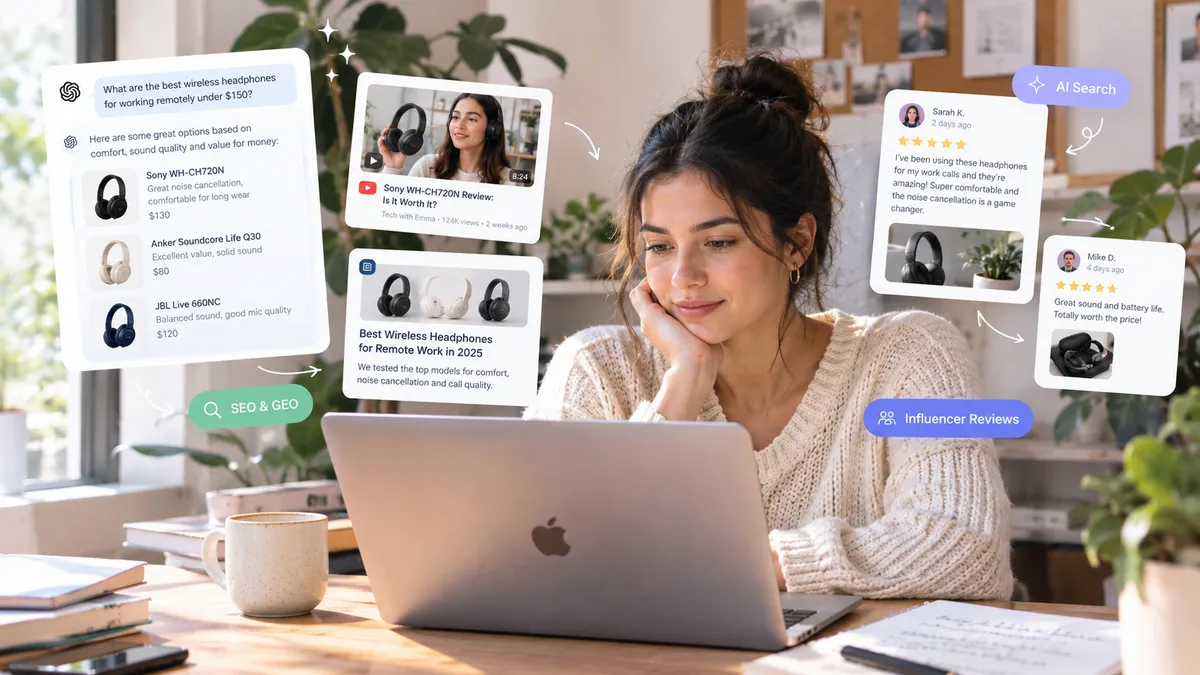
For example, imagine a consumer electronics brand selling wireless headphones. A potential customer might ask ChatGPT, "What are the best wireless headphones for working remotely under $150?"
A brand's product page may explain its technical specifications. A creator's YouTube review might demonstrate microphone quality, compare noise cancellation, and explain whether the headphones are comfortable during long meetings.
That additional context gives consumers a clearer understanding of the product. If the review is publicly accessible and used by an AI system, it may also become part of the information available for a recommendation.
AI visibility is not guaranteed, however. No influencer campaign can ensure that ChatGPT or another AI platform will mention a particular brand.
The opportunity is to create better information, strengthen brand credibility, and make it easier for potential customers to discover the product wherever they search.
Why Influencer Marketing Matters in the Age of AI Search
1. Consumers Are Asking AI for Product Recommendations
Search behavior is becoming more conversational.
A traditional search might look like this:
"Best standing desk"
An AI search might be much more specific:
"What's the best standing desk for a small home office, under $400, that is quiet and easy to assemble?"
The second query requires more than a list of products. Consumers want explanations, comparisons, and recommendations tailored to their circumstances.
Creator content can help fill that information gap. A detailed review might show how much space a desk occupies, how noisy its motor is, how long assembly takes, and whether it suits a small apartment.
For brands, this means influencer marketing should go beyond creating attractive promotional content. The goal is to help potential customers answer the questions that influence their purchase decisions.
2. Third-Party Content Can Strengthen Brand Credibility
Consumers don't always trust a brand's own claims. They often look for independent reviews, demonstrations, customer experiences, and comparisons before buying.
Creators can provide that additional perspective by showing products in real-world situations.
Consider a skincare brand launching a moisturizer. Instead of relying exclusively on a sponsored post announcing the product, the brand could collaborate with creators who regularly discuss skincare routines, ingredient compatibility, and products for different skin types.
A useful review might explain:
What skin type the moisturizer is designed for.
How the texture feels and how it fits into a daily routine.
How it compares with other products in the same price range.
What consumers should consider before purchasing.
These details are valuable to human readers regardless of whether an AI platform references the content. They can also help establish a more informative and consistent online presence.
The key is authenticity. Brands should not ask creators to manufacture positive opinions or make unsupported product claims. Credible content is more useful than repetitive advertising.
3. Niche Creators Can Reach High-Intent Audiences
A large following does not automatically make a creator the best partner for every campaign.
A celebrity may generate widespread awareness, while a smaller creator with deep knowledge of a product category may provide more useful answers to specific questions.
For example, a consumer looking for a mechanical keyboard for programming might prefer a creator who regularly tests switches, compares typing experiences, and explains compatibility over a general lifestyle influencer.
The same principle applies across industries. A home appliance brand may benefit from creators who specialize in home organization, product testing, or practical household advice. A fitness brand may find value in coaches who explain equipment, training methods, and product suitability.
When selecting creators, brands should evaluate subject expertise, audience relevance, content depth, and the creator's ability to explain product benefits—not just follower counts.
5 Ways to Adapt Your Influencer Strategy for AI Search
1. Choose Creators Based on Expertise and Content Quality
Start by identifying the questions customers ask before making a purchase.
Do they need product comparisons? Tutorials? Troubleshooting advice? Recommendations for a particular budget or lifestyle?
Use these questions to identify creators whose existing content naturally addresses the same topics.
For example, a smart-home brand could prioritize creators who publish installation guides, device comparisons, compatibility tests, and practical demonstrations. Their existing content provides evidence of their expertise and helps the brand assess whether the partnership will feel natural.
When evaluating potential creators, consider:
Niche relevance: Does the creator consistently publish content about your product category?
Audience fit: Are their viewers located in your target markets and likely to be interested in your products?
Content depth: Do they explain features and use cases, or primarily publish brief promotional mentions?
Engagement quality: Do viewers ask meaningful questions and discuss their experiences?
Search potential: Does the creator publish evergreen reviews, tutorials, or comparisons that people may continue discovering over time?
SocialBook can help brands explore relevant creators through its influencer search platform. Rather than selecting creators based on popularity alone, marketers can use creator research and audience insights to build a shortlist that better matches their campaign goals.
2. Turn Customer Questions Into Creator Briefs
A strong creator brief should begin with the customer's decision-making process, not a list of marketing slogans.
Before launching a campaign, gather common questions from customer service conversations, product reviews, sales teams, community discussions, and competitor content.
Then organize these questions into themes.
For a portable projector, the themes might include image quality, setup, portability, compatibility, and value for money.
A creator brief could ask the creator to demonstrate how the projector performs in a small room, explain which devices it supports, and discuss the situations in which it works best.
For a beauty product, the brief might focus on application, texture, ingredient information, suitability, and how the product fits into an existing routine.
The aim is to give creators a clear direction without forcing every video to follow the same script.
Useful guidelines include:
Mention the product's full name naturally in the video and caption.
Explain the intended audience and relevant use cases.
Answer genuine questions that buyers commonly ask.
Include meaningful comparisons when they are relevant and fair.
Use accurate captions, descriptions, and on-screen text.
Allow creators to share honest observations and limitations.
These practices improve the usefulness of the content for people while making its subject and context easier to understand.
3. Invest in Searchable, Evergreen Creator Content
Not every influencer deliverable serves the same purpose.
Short-form videos and Stories can be excellent for awareness, trend participation, and immediate engagement. However, some formats have a shorter useful life than detailed reviews or tutorials.
Brands seeking long-term discovery should consider adding evergreen content to their creator mix.
Examples include:
YouTube reviews: In-depth product testing, demonstrations, and comparisons.
How-to videos: Step-by-step instructions that address common problems or use cases.
Product comparison content: Balanced explanations of how products differ in features, pricing, and suitability.
Search-friendly social posts: Clear captions and relevant on-screen text that explain what the product is and why it matters.
Community discussions: Genuine conversations in relevant forums where people exchange advice and experiences.
For instance, a brand selling robot vacuums might combine short TikTok demonstrations with a detailed YouTube comparison covering pet hair, floor types, navigation, and maintenance.
The short videos can attract attention, while the longer review offers more detailed information to shoppers who are comparing options.
A balanced campaign can therefore support immediate reach and potentially longer-term discovery.
Remember that no format is automatically favored by every AI search engine. Indexing, platform access, content quality, and the search system itself all influence what may appear in an answer.
4. Build Consistent Coverage Across Multiple Creators
One sponsored mention can introduce a product to new audiences. A broader set of credible creator discussions can help consumers understand how the product performs in different situations.
Imagine a brand selling an ergonomic office chair.
One creator focuses on home-office setup. Another discusses posture and workstation comfort. A third compares office chairs at different price points. A fourth demonstrates how the chair adjusts for different desk heights.
Each creator contributes a different perspective while addressing a related set of customer needs.
This approach creates a more comprehensive body of product information than asking every creator to publish an identical promotional video.
To implement it, brands can:
Identify three to five important customer questions.
Match each question with creators who have relevant expertise.
Give each creator a distinct content angle.
Maintain consistent, accurate product information across briefs.
Track how each piece performs and whether it continues attracting attention.
For brands with ongoing creator programs, this can become a repeatable strategy rather than a one-time campaign.
The goal is not to flood the internet with identical mentions. It is to build useful coverage across relevant audiences, platforms, and customer questions.
5. Repurpose Creator Content Across Your Marketing Channels
Influencer content can provide value beyond the original social media post.
With appropriate usage rights and creator permissions, brands can reuse strong content on product pages, landing pages, FAQs, paid advertising, email campaigns, and other relevant channels.
For example, a creator's product demonstration might be embedded on a product page to show how a feature works. A frequently asked question from the video's comments could inspire a more detailed FAQ. A creator's comparison might help the marketing team identify which product benefits need clearer explanations on the website.
This creates a useful feedback loop between influencer marketing and SEO.
Creators reveal the questions and language that resonate with audiences. Marketing teams can use those insights to improve owned content. Better product pages then give shoppers another place to verify the information they discovered elsewhere.
For brands targeting AI search, this coordinated approach is more sustainable than treating influencer marketing and website optimization as separate activities.
How to Measure Influencer Marketing Performance in AI Search
Traditional influencer reporting usually focuses on reach, impressions, engagement, clicks, conversions, and revenue.
These metrics remain important. But if your objective includes AI search visibility, you may want to add a separate measurement layer.
AI recommendations are not fully predictable, and visibility can vary between platforms, queries, locations, and sessions. Treat AI visibility as an additional signal—not a guaranteed outcome or a replacement for sales measurement.
Track Brand Mentions in AI Answers
Build a list of questions that potential customers might ask ChatGPT, Gemini, Perplexity, or other AI search tools.
For example, a headphone brand might track:
What are the best wireless headphones for working remotely?
Which noise-canceling headphones are worth buying under $150?
What headphones have the best microphone for video calls?
How does Brand A compare with Brand B?
What should I look for when buying headphones for travel?
Run the same questions periodically and record whether your brand appears, how it is described, and which sources are cited when citations are available.
A simple monthly tracking sheet can include the query, AI platform, brand mention, cited source, competitor mentions, and changes from the previous check.
Because AI answers can change, repeat the checks and look for patterns rather than drawing conclusions from a single result.
Identify Which Creator Content Gets Cited
When an AI answer includes a YouTube review, comparison article, or public community discussion, examine the source.
Is it content from a creator your brand has partnered with? Does it mention your product accurately? Is it addressing a customer question that matters to your category?
Over time, these observations may help your team identify content formats and creator partnerships worth further investment.
Keep in mind that an AI citation does not automatically prove that a creator caused a brand mention or generated a sale. It is one piece of evidence to consider alongside other campaign data.
Monitor AI Referral Traffic
Use your website analytics to monitor visits from identifiable AI search sources, such as ChatGPT or Perplexity, where referral information is available.
Look at landing pages, engaged sessions, conversion rates, and revenue where measurable.
You may find that AI-referred visitors arrive on product comparisons, detailed guides, or specific product pages rather than your homepage.
These patterns can help your team understand which content supports visitors who are further along in their research.
Referral tracking has limitations: some AI-assisted journeys will not produce identifiable referral traffic, and attribution may be incomplete. Avoid assuming that every AI-influenced purchase can be measured directly.
Connect AI Visibility With Business Results
A practical reporting framework should combine three levels of measurement:
Visibility: Brand mentions in AI answers, cited creator content, traditional search impressions, and branded search trends.
Engagement: Creator views, meaningful comments, website visits, time spent on relevant pages, and interactions with product information.
Business outcomes: Leads, affiliate clicks, conversions, revenue, customer acquisition cost, and return on marketing spend.
This gives your team a more complete picture of performance without treating an AI mention as equivalent to a sale.
How SocialBook Can Support an AI Search-Ready Creator Strategy
Building an AI search-ready influencer strategy begins with understanding your market, identifying the right creators, and learning what customers want to know about your products.
SocialBook can support parts of this workflow through its creator search and marketing research capabilities.
Discover Creators Who Match Your Market
Use SocialBook Search to research creators relevant to your category, target audience, and campaign needs.
For an overseas brand entering the U.S. market, this could mean exploring creators in a specific product niche, reviewing their content, and comparing potential partners before outreach.
The objective is to find creators who can communicate your product's value clearly—not simply those with the largest audiences.
Research Competitors and Identify Content Opportunities
Look at which creators are discussing competing products and what types of content they publish.
Are competitors receiving attention through detailed reviews, tutorials, comparison videos, or product demonstrations? Which product questions appear repeatedly in public comments and discussions?
This research can help your team identify gaps in existing content and develop more useful creator briefs.
Competitor visibility does not guarantee that the same creators or content formats will work for your brand. Use the findings as a starting point for testing.
Use AI to Support Product and Market Planning
SocialBook's AI Product Diagnosis can help teams think through product positioning, target markets, social channels, creator tiers, and budget considerations.
These insights can inform the early stages of campaign planning. For example, a brand preparing to launch in the U.S. could use market and product analysis to clarify its audience before building a creator shortlist.
The resulting strategy should then be validated against actual creator performance, audience data, customer feedback, and campaign outcomes.
Explore SocialBook to begin researching creators and developing a more informed influencer marketing strategy.
Frequently Asked Questions
What is GEO in influencer marketing?
GEO stands for Generative Engine Optimization. In influencer marketing, it refers to efforts to make brand information more useful and discoverable in AI-generated answers. Relevant creator reviews, detailed product comparisons, and informative tutorials may contribute to the wider body of information that AI search systems use.
Can influencers help a brand appear in ChatGPT recommendations?
Potentially, yes. Publicly accessible creator content may be discovered, indexed, or referenced by AI-powered search systems. However, appearing in a creator's content does not guarantee that a brand will be mentioned in ChatGPT or another AI assistant.
Which creators are best for AI search visibility?
The best partners depend on your product category and audience. Creators who demonstrate relevant expertise, publish detailed content, answer real customer questions, and maintain an engaged, relevant audience may be strong candidates. Evaluate their content quality and audience fit alongside follower count and engagement.
Is YouTube better than TikTok or Instagram for AI search?
There is no universal winner. Detailed YouTube videos can provide rich context through narration, captions, descriptions, and chapters. TikTok and Instagram can be useful for product discovery and demonstrations, and publicly accessible content may also be searchable. The right mix depends on your audience, product, content format, and the platforms your target customers use.
How can brands measure AI search visibility?
Track a consistent set of buyer questions across relevant AI search tools, record brand mentions and available citations, monitor identifiable AI referral traffic, and compare the findings with creator engagement and sales data. Repeat the process regularly because results can change over time.
Should brands replace traditional SEO with GEO?
No. Traditional SEO, useful website content, credible creator partnerships, and AI search optimization can complement one another. Brands should continue building accessible, informative websites while creating creator content that answers customer questions across the channels where their audiences research products.
Final Thoughts: Make Your Brand Easier to Discover and Understand
AI search is adding another layer to the customer journey. Shoppers can now discover brands through conversational recommendations before visiting a product page or social media profile.
For marketers, the response is not simply to produce more influencer content. It is to create content that helps people make decisions: detailed reviews, useful comparisons, clear product demonstrations, and honest explanations of who a product is for.
Combine the right creators with thoughtful briefs, consistent coverage, useful website content, and measurement that goes beyond last-click attribution.
The result is a more connected marketing strategy—one that can support brand awareness, customer trust, organic discovery, and sales across both traditional and AI-powered search.
Ready to find creators for your next campaign? Explore SocialBook Search and start building a creator strategy around your brand, audience, and growth goals.
