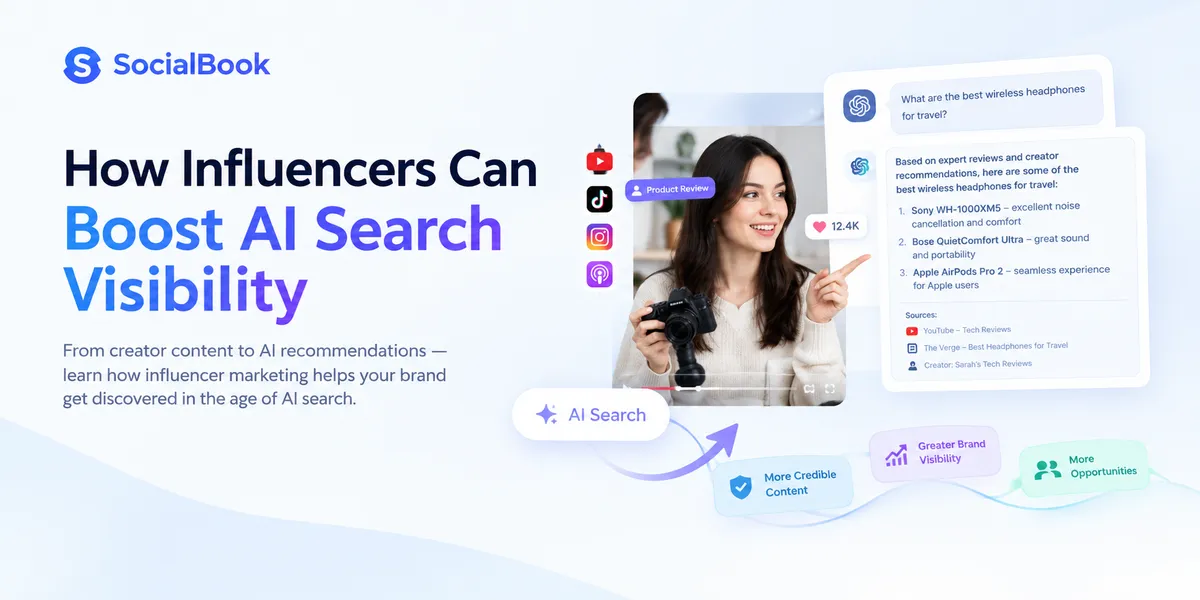
How Influencer Marketing Can Help Your Brand Get Discovered in AI Search
When consumers want product recommendations today, they don't always start with Google.
They might ask ChatGPT which skincare brand is best for sensitive skin, use Perplexity to compare home security cameras, or turn to Google's AI-powered search results to find the best products for their needs.
For brands, this creates a new challenge: How do you get recommended by AI when customers are researching products?
Traditional SEO focuses on helping pages rank in search results. AI search adds another layer. Brands also need to become recognizable, credible, and easy to understand across the sources AI systems use to generate answers.
This is where influencer marketing becomes especially interesting.
Creators publish product reviews, comparisons, tutorials, and first-hand experiences across platforms such as YouTube, blogs, podcasts, and online communities. These materials can help potential customers discover a brand and give AI systems additional sources of information about its products.
However, influencer marketing does not guarantee AI citations or rankings. The real opportunity is to build a stronger digital presence through useful creator content, credible third-party mentions, and consistent product information.
Here's how brands can approach influencer marketing to improve their visibility in AI search.
What Is AI Search Visibility, and Why Does It Matter?
AI search visibility refers to how often a brand appears in AI-generated answers when people ask questions related to its products, services, or industry.
For example, imagine a consumer asks an AI assistant:
What are the best robot vacuums for homes with pets?
Which skincare brands are suitable for sensitive skin?
What are some affordable alternatives to premium wireless headphones?
Which influencer marketing platforms are best for small ecommerce brands?
An AI-generated answer may mention several brands, explain their differences, and cite external sources.
If your brand consistently appears in relevant answers, you have another opportunity to reach potential customers before they visit a traditional search results page.
This emerging area is often discussed under terms such as Generative Engine Optimization (GEO), AI SEO, and Answer Engine Optimization (AEO). Although the terminology varies, the underlying goal is similar: make your brand easier to discover and understand across changing search experiences.
For a deeper look at this shift, read our related guide on AI tools for influencer marketing in 2026, which explores how AI is changing creator discovery and campaign planning.
Why Influencers Matter for AI Search
1. Creators Give Brands Third-Party Credibility
A brand website can explain what a product does, but consumers often want more than a company's own claims. They want to see how a product performs in real situations.
That is why independent reviews, tutorials, product comparisons, and expert opinions are valuable.
Consider a consumer researching a new pair of running shoes. The brand's website might highlight cushioning, durability, and comfort. Meanwhile, running creators may publish detailed reviews about how the shoes perform on long runs, different surfaces, or specific foot types.
Together, these sources provide a broader picture of the product.
AI systems may use publicly available third-party information when answering product-related questions. Creator content can therefore contribute to the wider body of information available about a brand.
The important distinction is that more influencer mentions do not automatically translate into more AI recommendations. The relevance, credibility, accessibility, and usefulness of the content all matter.
2. Influencers Answer the Questions Buyers Actually Ask
Many people discover products through questions rather than brand names.
They might search for the best product for a particular budget, compare two competing models, or look for an honest review before purchasing.
Creators are well positioned to address these needs because their content often reflects real customer concerns.
For example, a tech creator might publish a video comparing three wireless earbuds based on sound quality, battery life, comfort, and price. A beauty creator might explain how different moisturizers perform on dry and acne-prone skin.
These formats naturally align with the questions consumers ask search engines and AI assistants.
Brands can use these insights to identify content opportunities around:
Product comparisons and alternatives
Tutorials and how-to guides
Use cases for specific customer groups
Common product problems
Buying guides and budget recommendations
Honest reviews that discuss both advantages and limitations
The goal is not to make every creator repeat a marketing slogan. It is to help creators produce useful content that addresses genuine audience questions.
3. Long-Form Content Can Provide More Context
Short-form videos are excellent for discovery, entertainment, and quick product demonstrations. However, some questions require more explanation.
A 15-second clip might show a robot vacuum cleaning a floor. A detailed YouTube review could explain its navigation system, obstacle avoidance, noise level, maintenance requirements, and performance around pet hair.
That additional context can be useful to consumers and may make the content more relevant to specific informational queries.
For brands seeking AI search visibility, consider combining formats rather than choosing just one.
Short-form videos can introduce a product and spark interest. Long-form reviews, comparison videos, podcasts, and detailed articles can explore the product in greater depth.
When working with YouTube creators, make sure the video title, description, chapters, captions, and product references accurately reflect the content. These elements also make the information easier for people to navigate.
7 Ways to Use Influencer Marketing to Improve AI Search Visibility
1. Start by Auditing Your Brand's AI Visibility
Before launching a creator campaign, understand how AI assistants currently describe your brand.
Test a consistent set of relevant prompts across tools such as ChatGPT, Gemini, and Perplexity.
For example, an electronics brand might ask:
What are the best home security cameras for renters?
Which home security camera brands offer the best value?
Compare Brand A and Brand B for outdoor use.
What should I consider before buying a wireless security camera?
Record whether your brand appears, which competitors are mentioned, how your products are described, and which sources are cited.
Repeat the same prompts over time. AI answers can vary by model, query wording, location, and when the search is conducted, so a single result should not be treated as definitive evidence.
This audit can help you identify three important opportunities:
Brand awareness gaps: Competitors appear in relevant answers, but your brand does not.
Content gaps: AI answers address questions your website and creator content do not cover well.
Source gaps: Other publishers, reviewers, or creators appear in citations, suggesting potential opportunities for outreach and collaboration.
Use these findings to guide your influencer strategy instead of choosing creators based only on popularity.
2. Choose Creators Based on Expertise, Not Just Followers
A large audience can be valuable, but follower count alone does not establish whether a creator is useful for AI search visibility.
Imagine a brand selling professional microphones.
A general entertainment influencer with two million followers may generate considerable awareness. However, an audio specialist who regularly compares microphones, recording equipment, and sound quality may be better suited to explaining the product in depth.
When evaluating creators, consider:
Niche relevance: Does the creator consistently cover your product category?
Subject knowledge: Can they explain meaningful differences between products?
Content depth: Do they publish reviews, tutorials, comparisons, or other informative content?
Audience fit: Does their audience match your target market?
Credibility: Do their reviews demonstrate independent judgment and authentic experience?
Search presence: Does their existing content appear for relevant search queries or in AI-generated answers?
You should also review engagement quality, audience demographics, and signs of suspicious follower activity.
If you're building a shortlist, our guide to using an influencer search engine to find and vet creators explains how brands can use structured creator data to narrow their options before reaching out.
3. Prioritize Platforms and Formats That Match Your Goals
Different platforms serve different purposes. Your strategy should reflect both your audience's habits and the type of information you want creators to communicate.
YouTube: Useful for detailed product reviews, demonstrations, tutorials, and side-by-side comparisons. Video descriptions, chapters, and transcripts can provide additional context.
Blogs and specialist websites: Useful for in-depth reviews, product roundups, buying guides, and written comparisons that can be crawled and indexed when publicly accessible.
Podcasts: Useful for expert discussions, interviews, and long-form conversations. Published transcripts and accompanying articles can make the information easier to discover.
Reddit and online communities: Useful for understanding customer questions, product concerns, and authentic conversations. Brands should participate transparently and respect community rules rather than manufacture endorsements.
LinkedIn: Particularly relevant for B2B brands. Expert commentary, case studies, and detailed posts can help establish knowledge in a professional category.
Instagram and TikTok still matter. They can introduce products, build familiarity, and generate interest that leads consumers to seek more information elsewhere.
A balanced campaign might use short-form content for awareness, long-form creator reviews for deeper evaluation, and supporting written content to answer specific buyer questions.
There is no universally best platform for every AI system or industry, so validate your choices against your own audience and visibility data.
4. Brief Creators Around Specific Customer Questions
A vague brief such as "talk about our product and explain why you love it" may produce entertaining content, but it does not necessarily answer the questions buyers need help with.
Instead, give creators a clear topic, relevant product information, and the freedom to develop their own perspective.
For example, a skincare brand could collaborate with a creator on:
"How to Choose a Moisturizer for Dry, Sensitive Skin"
A useful review might cover:
Who the product is designed for
Its key ingredients and intended benefits
Texture and application
How it fits into a skincare routine
Potential limitations or ingredients some users may wish to avoid
How it compares with other options
Where customers can find accurate product information
For an electronics brand, a brief might focus on "What to Look for When Buying a Home Security Camera."
This approach creates content that helps the audience make a decision instead of simply repeating promotional claims.
Provide accurate product specifications, approved links, and important details, but avoid scripting every sentence. Authenticity depends on creators being able to communicate in their own voices.
Sponsored content should also be disclosed clearly and comply with applicable advertising regulations.
5. Build Consistent Coverage Across Multiple Credible Sources
One creator review can introduce a product to a new audience. A broader collection of useful, independent content can help consumers understand the brand from several perspectives.
For example, a home appliance brand might work with:
A specialist YouTube reviewer for a detailed product test
A home organization creator for practical demonstrations
A lifestyle blogger for a product comparison
A relevant publisher for a buying guide
Existing customers who voluntarily share their experiences
Each source serves a different audience and answers different questions.
The aim is not to make every creator publish identical language. That can make the campaign feel artificial and reduce the value of individual perspectives.
Instead, establish consistent facts about the product while allowing each creator to focus on a distinct use case.
This can help reduce confusion when consumers encounter your brand across different channels.
It is also important to distinguish earned coverage from paid placements. Paid partnerships can provide valuable exposure, but they should never be presented as independent editorial endorsements. Neither paid nor organic coverage guarantees that an AI system will cite the content.
6. Make Creator Content Easy to Find and Understand
Even a helpful review has limited discovery value if people cannot find it or its content is difficult to interpret.
Work with creators to improve the basic information surrounding each publication.
For video content, consider:
Descriptive titles that reflect the actual topic
Detailed descriptions with relevant product information
Accurate captions and transcripts
Chapters for longer videos
Clear model names and product references
Links to the official product page
For blog content, consider:
A clear heading structure
Specific product names and relevant terminology
Useful comparisons and supporting evidence
Descriptive links to authoritative product information
Updated specifications and availability
A clear explanation of who the product is best suited for
Your own website also needs to support the information being published elsewhere. Maintain accurate product pages, consistent brand descriptions, helpful FAQs, and accessible technical information.
For more guidance on evaluating creators before investing in collaborations, see our article on AI tools for influencer marketing.
7. Measure AI Visibility Alongside Traditional Influencer Metrics
Traditional influencer reports often focus on reach, impressions, engagement, clicks, and sales. These metrics remain important, but they do not fully capture whether your brand is becoming more visible in AI-generated answers.
Consider adding AI visibility measurements to your reporting.
Brand mention rate: How often does your brand appear across a fixed set of relevant AI prompts?
Share of voice: How frequently is your brand mentioned compared with competitors in the same category?
Citation frequency: Which external pages or creator publications are cited in the answers you track?
Brand accuracy: Does AI describe your products, features, and positioning correctly?
Referral traffic: Are visits arriving from AI search experiences, where your analytics tools can identify the source?
Traditional campaign performance: Are creator collaborations also generating engagement, qualified traffic, conversions, or revenue?
Establish a baseline before a campaign begins. Then repeat your prompt tests on a consistent schedule, record the model and query used, and compare results over time.
Remember that these measurements are not interchangeable. A brand mention is not necessarily a citation, and a citation does not prove that a specific influencer campaign caused a visibility increase.
AI answers can change for many reasons, including new content, model updates, competitor activity, and differences in query wording.
The strongest approach is to evaluate AI visibility alongside conventional marketing results rather than treating it as a replacement for them.
How to Find the Right Influencers for an AI Search Strategy
Once you've identified the questions you want to answer and the platforms you want to target, the next challenge is finding creators who can deliver the right kind of content.
A practical process looks like this:
Step 1: Define your priority topics.
List the product categories, use cases, comparisons, and customer questions where you want your brand to become more discoverable.
Step 2: Identify relevant creator niches.
Search for creators who already publish content about those topics. A narrow, relevant niche can be more valuable than a broad audience with little interest in your category.
Step 3: Review content quality.
Look at previous reviews, tutorials, and comparisons. Determine whether the creator provides useful explanations, demonstrates real product knowledge, and maintains audience trust.
Step 4: Evaluate audience and campaign fit.
Review audience location, demographics where available, engagement quality, content format, estimated costs, and past brand partnerships.
Step 5: Check existing search visibility.
Search for the creator's published content using relevant product and category queries. You can also test whether their content appears among the sources cited by AI tools. Treat these observations as useful signals, not guarantees of future performance.
Step 6: Build a diversified creator portfolio.
Combine creators with different strengths. For example, use specialist reviewers for technical depth, lifestyle creators for practical use cases, and subject experts for educational content.
SocialBook can support this workflow through creator search, audience insights, competitor research, and campaign discovery. The goal is to move from a broad list of potential influencers to a shortlist based on your actual product and marketing objectives.
Common Mistakes to Avoid
Chasing Mentions Instead of Useful Content
Getting your brand name into as many posts as possible is not the same as building credibility.
Prioritize content that explains your product accurately, answers relevant questions, and gives consumers a genuine reason to consider your brand.
Choosing Creators Only by Follower Count
A large following does not guarantee expertise, audience relevance, or useful search content.
Evaluate the creator's topic history, content depth, audience quality, and ability to explain your product.
Treating AI Search as a Guaranteed Ranking Channel
No influencer agency or creator campaign can guarantee that ChatGPT, Gemini, or another AI system will recommend your brand.
AI visibility is influenced by multiple sources and technical factors. Treat influencer marketing as one component of a broader discoverability strategy.
Ignoring Your Own Website
Creator content can introduce a brand, but customers may still visit your website to verify product information or compare options.
If your website has incomplete product details, inconsistent messaging, or unclear positioning, you may lose opportunities to convert that interest into action.
Measuring Success Too Early
AI search results can fluctuate, and some creator content takes time to be discovered.
Use repeatable tests and longer-term reporting. Evaluate both the direction of AI visibility and the commercial performance of the campaign.
Frequently Asked Questions
Can influencers help a brand appear in ChatGPT answers?
They can contribute to the broader information environment that AI systems draw on. Detailed reviews, tutorials, expert commentary, and other relevant third-party content may help consumers discover and understand a brand. However, influencer collaborations cannot guarantee that ChatGPT will mention or recommend a product.
Which type of influencer is best for AI search visibility?
It depends on the product and audience. Specialist reviewers, educators, industry experts, and creators who regularly publish useful long-form content can be good candidates when their expertise matches the questions buyers ask. Follower count alone is not a reliable selection criterion.
Is YouTube important for AI search?
YouTube is worth evaluating because it supports detailed reviews, tutorials, product comparisons, and transcripts. However, different AI systems use different sources, and platform visibility varies by topic. Brands should test their own category rather than assume one platform will always dominate.
Should brands prioritize GEO over traditional SEO?
No. GEO and AI search optimization should complement a solid SEO foundation. Maintain useful website content, accurate product information, technical accessibility, and credible third-party coverage while monitoring how AI search experiences evolve.
How can brands measure influencer-driven AI visibility?
Track a consistent set of relevant prompts, brand mentions, competitor mentions, cited sources, and the accuracy of AI-generated descriptions. Compare those findings with creator publication dates, referral traffic, engagement, and conversions. Because correlation does not prove causation, report the results as observed trends rather than guaranteed campaign impact.
Does sponsored influencer content count?
Sponsored content can help consumers learn about a product and may be publicly accessible to search systems. Its value depends on the content, context, accessibility, and how it is presented. Ensure sponsorships are disclosed and avoid making unsupported claims or presenting paid endorsements as independent opinions.
Final Thoughts: Build a Brand That People and AI Can Understand
AI search is changing how consumers research products, compare alternatives, and discover brands. Influencer marketing can play a role in this shift by creating useful third-party content that answers real questions and provides additional context about products.
The best starting point isn't to ask creators to mention your brand more often. It is to understand what your audience wants to know, identify credible creators who can answer those questions, and build content that genuinely helps people make decisions.
Combine that approach with strong website content, accurate product information, consistent measurement, and a thoughtful creator discovery process.
SocialBook helps brands explore creator opportunities through influencer discovery, audience insights, competitor research, and campaign workflows. By choosing creators based on relevance and content quality, marketers can build a more informed influencer strategy for an evolving search landscape.
Want to find creators who fit your product and target market? Explore SocialBook's influencer search and discovery tools to start building your shortlist.
