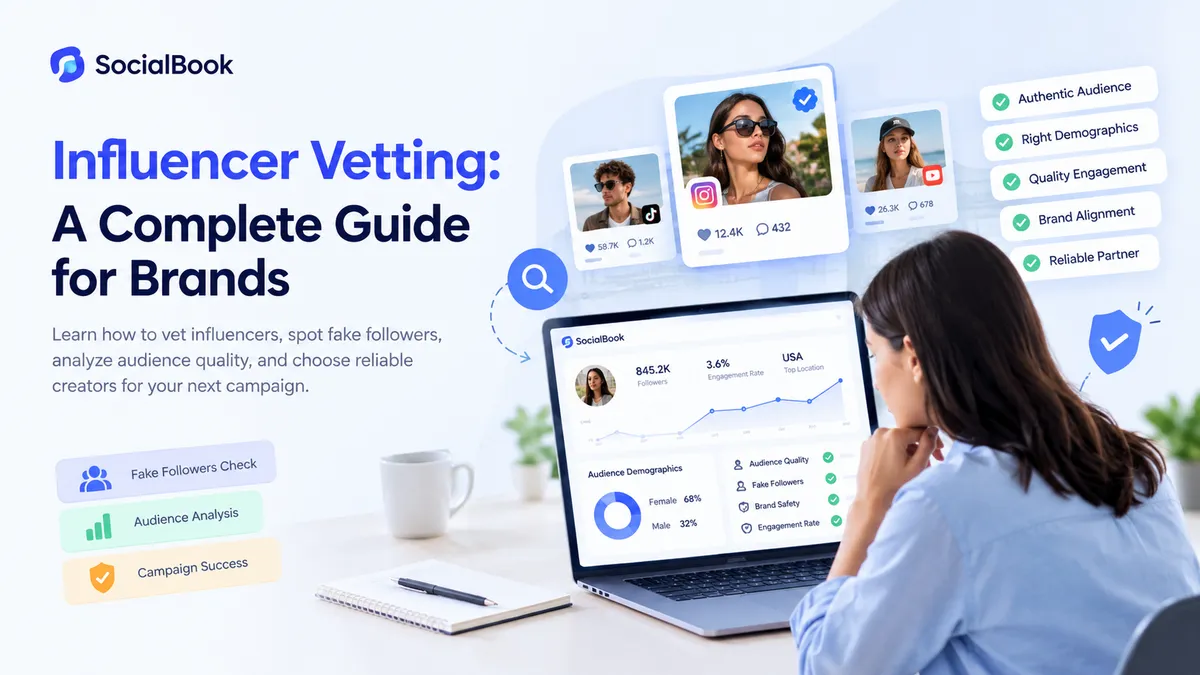
Influencer Vetting: How to Find Creators Your Brand Can Trust
Finding an influencer with a large following is easy. Finding one who reaches the right audience, creates authentic content, and delivers meaningful results is a different challenge.
For brands investing in influencer marketing, choosing the wrong creator can mean more than wasted budget. A poor partnership can delay a product launch, attract the wrong audience, or generate thousands of views without a meaningful increase in sales.
That's why influencer vetting matters.
Influencer vetting is the process of evaluating a creator's audience authenticity, engagement quality, content, brand alignment, and reliability before entering a collaboration. It helps brands make informed decisions based on evidence rather than follower counts or attractive profile pages.
In this guide, we'll walk through how to vet influencers step by step, identify potential red flags, and build a repeatable evaluation process that helps your next campaign perform better.
What Is Influencer Vetting?
Influencer vetting is the process of assessing whether a creator is a suitable partner for your brand before committing to a collaboration.
A proper evaluation goes beyond checking how many followers someone has. It examines whether those followers are real, whether the audience matches your target customers, whether the creator produces relevant content, and whether their past performance suggests they can support your campaign goals.
There are five essential areas to evaluate:
Audience authenticity: Are the creator's followers and interactions genuine?
Audience relevance: Does the creator reach the right countries, age groups, interests, and potential buyers?
Engagement quality: Do people meaningfully interact with the content?
Brand alignment: Does the creator's content, tone, and reputation fit your brand?
Professional reliability: Can the creator communicate clearly and deliver the agreed content on time?
A creator doesn't need to be perfect in every category. However, brands should understand the risks before deciding whether a partnership is worth the investment.
Why Is Influencer Vetting Important?
Influencer marketing can introduce a brand to new audiences, build trust, and generate sales. But these outcomes depend heavily on selecting the right partners.
1. Avoid Spending Money on Fake or Inactive Audiences
A creator may have 200,000 followers, but that number alone doesn't tell you how many people actually see or care about their content.
If a significant portion of the audience consists of inactive or suspicious accounts, the brand may pay for reach that never translates into real attention.
Vetting helps identify unusual follower growth, weak engagement, and suspicious interactions before campaign money is committed.
2. Reach People Who Are More Likely to Buy
Audience size means little if the creator's followers don't match your target market.
For example, a US skincare brand may find a creator with excellent engagement, but if most of that creator's audience lives in countries where the product isn't available, the partnership may generate awareness without driving sales.
Audience location, age, interests, and purchasing relevance should all influence your decision.
3. Protect Your Brand Reputation
Influencers represent your brand when they publish sponsored content. Their communication style, past posts, and previous brand partnerships can influence how consumers perceive your business.
Reviewing historical content helps you identify potential conflicts, misleading claims, inappropriate content, and inconsistent disclosure practices before a collaboration goes live.
4. Improve Campaign Performance
The right creator should be selected according to your campaign objective.
If your goal is awareness, reach and video views may matter most. If you're trying to drive conversions, audience relevance, content credibility, and historical sales performance may be more important.
Understanding which influencer marketing metrics matter most to brands can help you evaluate creators according to the results you actually need.
How to Vet Influencers: 7 Essential Checks
1. Check Follower Growth for Unusual Patterns
Start by reviewing the creator's follower growth over time.
Healthy accounts often experience gradual growth, with occasional spikes following viral posts, collaborations, or successful campaigns. Sudden increases without an obvious explanation may deserve closer investigation.
Look for:
Large follower increases that don't correspond with popular content.
Repeated growth spikes followed by sharp declines.
Follower counts that seem inconsistent with the creator's typical reach.
Limited audience growth despite frequent, high-performing content claims.
Keep in mind that unusual growth isn't proof of fake followers. A viral video or external media coverage can cause legitimate spikes. Treat suspicious patterns as a reason to investigate further, not an automatic reason to reject a creator.
2. Analyze Engagement Rate and Interaction Quality
Engagement rate helps you understand how actively an audience interacts with a creator's content.
A commonly used formula is:
Engagement Rate by Followers = Total Engagements ÷ Total Followers × 100%
Total engagements may include likes, comments, and other publicly available interactions, depending on the platform and the calculation method.
For example, if a creator has 50,000 followers and receives an average of 1,500 likes and comments per post, their engagement rate by followers would be approximately 3%.
However, there is no universal engagement rate that guarantees success. Results vary by platform, niche, creator size, content format, and campaign objective.
To make a fair comparison, evaluate several creators within the same niche and a similar follower range. Review multiple recent posts instead of relying on one unusually successful video.
Also, look beyond the percentage. A smaller creator with thoughtful comments and genuine conversations may be more valuable than a larger account with shallow interactions.
3. Look for Fake Followers and Suspicious Engagement
Fake followers can make a creator appear more influential than they really are.
Common warning signs include:
Large numbers of followers with blank profiles or little activity.
Repeated, generic comments that don't relate to the content.
Similar comments appearing across multiple posts.
Engagement that seems disproportionate to the creator's normal performance.
Audience demographics that don't make sense for the creator's content or target market.
Manual review is useful, but it can become time-consuming when you're evaluating dozens or hundreds of potential partners.
A dedicated Instagram fake follower checker can help brands investigate suspicious audience patterns more efficiently.
SocialBook also provides influencer discovery and analysis capabilities that help marketers assess creators before outreach. You can begin by exploring the SocialBook influencer search platform.
Remember that automated checks provide estimates and signals, not definitive proof that an account has purchased followers. Combine tool-based analysis with a review of the creator's actual content and audience behavior.
4. Verify Audience Demographics and Location
One of the most important questions to ask is whether the creator reaches the people your brand wants to attract.
Review audience insights such as:
Geography: Are followers concentrated in your target countries?
Age: Do followers fall within your intended customer demographic?
Gender: Where relevant, does the audience match your product's target market?
Interests: Does the audience show an interest in your category?
Language: Can the creator communicate naturally with your intended customers?
For example, an American beauty brand launching a new skincare line may prioritize creators whose audiences are concentrated in the United States and regularly engage with beauty-related content.
A creator with fewer followers but a highly relevant audience may offer better campaign value than someone with a much larger, less relevant following.
Whenever possible, request current audience insights directly from the creator. Public profile information alone may not reveal the complete picture.
5. Review Content Quality, Consistency, and Brand Safety
A creator's profile is a portfolio of how they communicate with their audience. Review several months of content rather than judging the account from its latest post.
Consider the following questions:
Does the creator publish consistently?
Is the content original, engaging, and well-produced enough for your campaign?
Can they explain products naturally rather than simply repeating a sales script?
Do their tone and visual style fit your brand?
Have they previously promoted products similar to yours?
Do their sponsored posts appear credible and appropriately disclosed?
Pay attention to how the creator handles partnerships. If every post feels like an advertisement, the audience may be less receptive to another sponsored message.
You should also check whether the creator's recent content conflicts with your brand values or includes claims that could create reputational or compliance risks.
The objective isn't to control a creator's entire online presence. It's to understand whether the partnership makes sense for your brand.
6. Evaluate Previous Brand Collaborations
Past partnerships can reveal useful information about a creator's experience, professionalism, and potential fit.
Look for brands they've worked with, the type of sponsored content they produced, and how their audience responded.
Questions worth asking include:
Have they collaborated with brands in your category?
Did their previous sponsored posts receive meaningful engagement?
Are they currently working with a direct competitor?
Do they have any exclusivity obligations that could affect your campaign?
Can they provide relevant examples or performance results from previous collaborations?
Don't assume that working with competitors automatically disqualifies a creator. In some cases, it demonstrates strong category expertise. The important thing is to understand any conflicts and agree on clear partnership terms.
When evaluating creators, compare their previous work against your campaign requirements rather than choosing the person with the most recognizable brand names on their profile.
7. Test Communication and Delivery Reliability
A creator can have an authentic audience and excellent content but still be difficult to work with.
Slow responses, unclear pricing, missed deadlines, and incomplete deliverables can create problems for campaigns with strict launch schedules.
Before booking, evaluate how the creator handles initial communication. Do they answer questions clearly? Can they explain their rates and deliverables? Are they realistic about production and posting timelines?
Ask the creator to confirm:
Availability and expected posting dates.
Deliverables, such as Reels, TikToks, Stories, or YouTube videos.
Pricing and any additional production fees.
Revision limits and approval requirements.
Content usage rights, including whether paid advertising usage is included.
Sponsored content disclosure requirements.
Reporting expectations after publication.
Put the agreed terms in writing. For time-sensitive campaigns, consider maintaining a shortlist of backup creators in case a partnership falls through.
Influencer Vetting Checklist: What to Review Before You Book
Use this checklist to standardize your evaluation process across creators.
Evaluation area | What to check | Potential warning sign |
|---|---|---|
Follower growth | Historical growth patterns | Unexplained spikes or repeated sharp drops |
Engagement | Performance across recent posts | Unusually weak or inconsistent interactions |
Comment quality | Relevance and authenticity | Repetitive, generic comments |
Audience demographics | Location, age, interests | Audience doesn't match target customers |
Content quality | Consistency, originality, tone | Poor fit for your brand or campaign |
Brand safety | Historical posts and disclosure habits | Reputational or compliance concerns |
Previous partnerships | Competitor relationships and sponsored content | Conflicts or unclear exclusivity |
Communication | Response quality and availability | Unclear answers or repeated delays |
Commercial terms | Pricing, usage rights, deliverables | Unspecified costs or responsibilities |
Performance evidence | Historical reach, clicks, or conversions | Unsupported performance claims |
Not every warning sign means a creator should be rejected. Instead, use the checklist to identify questions that need answers before you commit.
For larger campaigns, consider assigning a consistent internal score to each category so that different team members evaluate creators using the same criteria.
How to Build a More Efficient Influencer Vetting Workflow
Manual vetting works when you're reviewing a handful of creators. It becomes much harder when you're sourcing partners across multiple countries, platforms, and product categories.
A repeatable workflow makes the process more efficient without sacrificing evaluation quality.
Step 1: Define Your Ideal Creator Profile
Before searching, establish your campaign goals, target audience, preferred platforms, budget, and content requirements.
For instance, a campaign designed to generate US ecommerce sales may prioritize audience location, product relevance, and conversion potential over total follower count.
Clear criteria help you eliminate unsuitable candidates early.
Step 2: Discover Creators Using Relevant Filters
Instead of browsing profiles at random, narrow your search by niche, platform, location, follower range, and engagement characteristics.
A dedicated influencer search engine can help you identify potential partners more efficiently and build a structured shortlist.
SocialBook helps brands discover creators across supported social platforms and analyze profiles as part of the selection process.
Step 3: Screen the Shortlist
Once you have a shortlist, examine audience authenticity, demographics, engagement, content quality, and previous partnerships.
Start with the information available in creator profiles, then request additional analytics from the strongest candidates.
For brands working with smaller creators, our guide on how to find micro-influencers for free offers additional ways to discover relevant partners without relying entirely on expensive campaigns or manual searches.
Step 4: Contact Creators and Confirm the Details
Reach out to shortlisted creators with a personalized message that explains why you think they're a good fit.
Share the product, campaign objective, expected deliverables, budget range when appropriate, and anticipated timeline. Ask for any missing audience insights or performance data before finalizing the agreement.
Clear communication at this stage helps you assess both professional fit and practical feasibility.
Step 5: Track Performance After the Campaign
Vetting shouldn't stop when the contract is signed.
Once the content goes live, compare actual performance against your original campaign objectives. Track relevant metrics such as reach, views, engagement, clicks, conversions, and revenue.
This information helps you understand which creators are worth working with again and improves future selection decisions.
A creator who performed well for brand awareness may not necessarily be the best partner for direct-response campaigns. Evaluate results according to the objective rather than applying one standard to every collaboration.
Common Influencer Vetting Mistakes to Avoid
Even experienced marketing teams can make avoidable mistakes when choosing creators.
Choosing creators based on follower count alone. A large audience doesn't guarantee authentic engagement, relevant demographics, or sales potential.
Using a single metric to judge performance. Engagement rate, for example, is useful but cannot independently establish audience quality or conversion potential.
Ignoring audience geography. A creator may generate substantial engagement in markets where your product isn't available.
Reviewing only recent or viral posts. A single high-performing post may not reflect the creator's typical results. Examine multiple posts and, where possible, request average performance data.
Failing to clarify commercial rights. Content creation fees don't necessarily include permission to reuse content in paid advertisements, on product pages, or across other marketing channels.
Skipping post-campaign evaluation. Without recording actual results, brands may repeat partnerships based on impressions rather than measurable outcomes.
The solution is to make vetting a consistent part of your influencer marketing process, rather than a last-minute check before payment.
Frequently Asked Questions About Influencer Vetting
What does influencer vetting mean?
Influencer vetting is the process of evaluating a creator before a brand enters a partnership. It includes checking audience authenticity, demographics, engagement quality, content history, brand alignment, and professional reliability.
How can you tell if an influencer has fake followers?
Look for unexplained follower growth, repetitive comments, suspicious engagement patterns, and audience characteristics that don't align with the creator's content. Fake follower analysis tools can help identify potential warning signs, but no single signal proves that followers are fake.
What is a good engagement rate for an influencer?
There is no universal benchmark that applies to every platform and niche. Compare creators with similar audience sizes, content formats, and industries, and consider engagement quality alongside the overall rate.
Should brands ask influencers for audience insights?
Yes. Audience insights can help verify whether a creator reaches your intended markets and demographics. For important partnerships, request recent analytics screenshots or platform-generated reports where available.
How many influencers should a brand vet before a campaign?
The number depends on your campaign budget, goals, and expected number of partnerships. Vetting a larger pool can help you compare candidates, but the objective is to identify a manageable shortlist of suitable creators rather than maximize the number reviewed.
Can influencer marketing tools help with vetting?
Yes. Influencer marketing platforms can streamline creator discovery, filtering, profile analysis, and audience evaluation. SocialBook helps brands discover and assess creators, making it easier to organize the selection process before outreach and collaboration.
Final Thoughts
Successful influencer marketing starts before the first sponsored post goes live. It starts with choosing creators who can reach the right audience, represent your brand authentically, and contribute to your campaign goals.
A reliable influencer vetting process combines data analysis with human judgment. Review audience authenticity, compare engagement quality, examine content history, confirm audience relevance, and establish clear expectations before booking.
Most importantly, treat vetting as an ongoing learning process. Use campaign results to refine your creator selection criteria and build a stronger network of long-term partners.
With the right process and tools, brands can spend less time guessing which creators to trust and more time building partnerships that deliver measurable value.
Ready to find and evaluate creators for your next campaign? Explore SocialBook's influencer search platform to discover potential partners and start building a more data-driven influencer marketing strategy.
