How Often Should You Post on LinkedIn in 2026? A Data-Driven Guide
How often should you post on LinkedIn to grow your audience, increase engagement, and build professional credibility? Should you publish every day, three times a week, or only when you have something valuable to share?
The answer isn't simply "the more, the better."
LinkedIn has become an important platform for B2B marketers, founders, consultants, and industry experts. But maintaining visibility requires more than publishing content frequently. You also need to understand what your audience wants to read, when they are most active, and whether your content is generating meaningful engagement.
Recent industry research offers some useful clues. LigoSocial's September 2026 study analyzed 134,522 LinkedIn posts from 1,499 profiles and found that accounts publishing consistently grew their followers faster than accounts posting infrequently. Meanwhile, Favikon's analysis of its top 50 LinkedIn creators found that most published between two and five times per week.
So, what's the right posting schedule for your account?
In this guide, we'll explore LinkedIn posting frequency benchmarks, how publishing habits influence engagement, and how businesses can build a sustainable content strategy in 2026.
How Often Should You Post on LinkedIn?
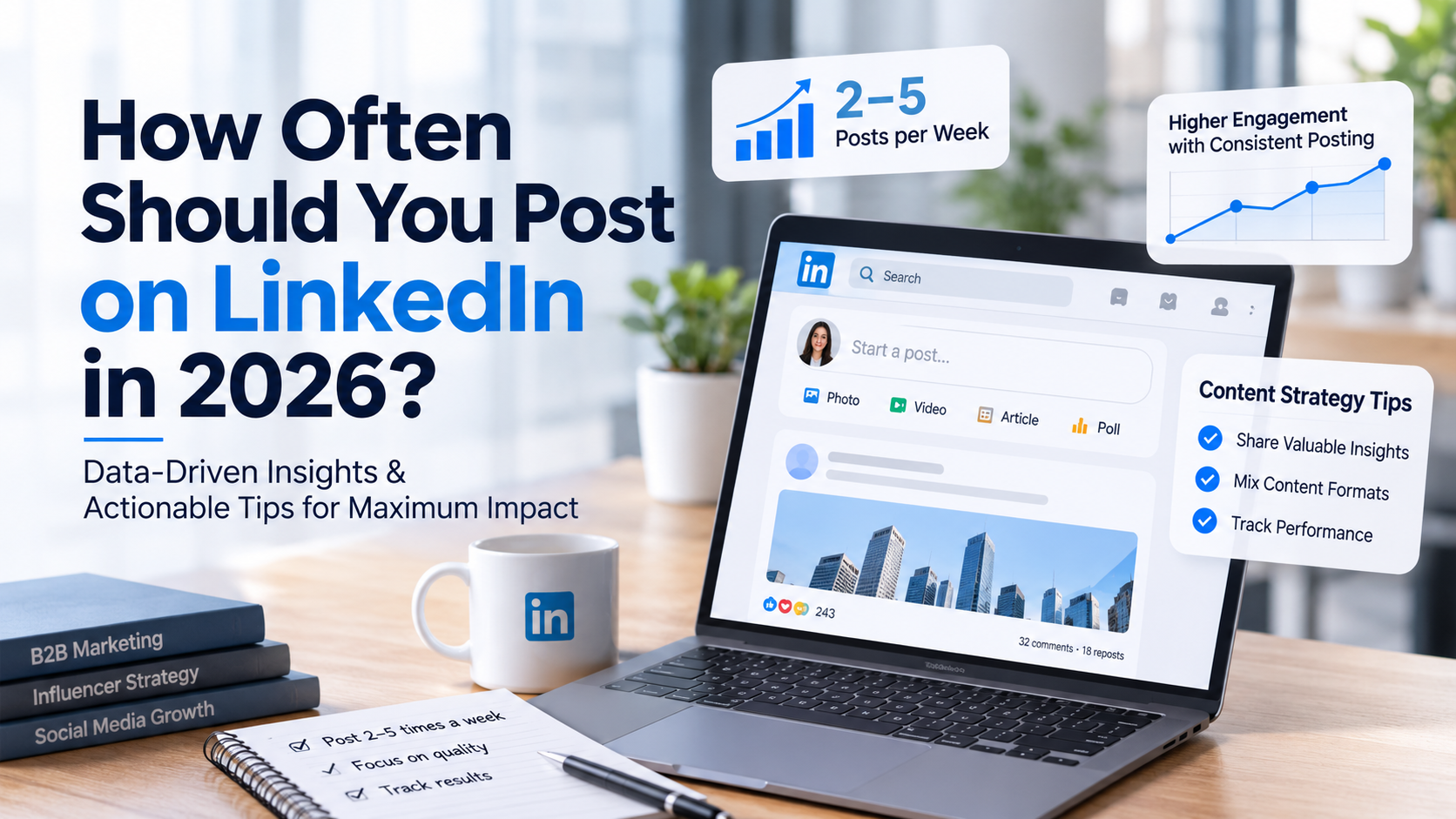
For most professionals and business accounts, posting 2–5 times per week is a reasonable starting point.
This frequency provides enough opportunities to reach your audience without making content production unnecessarily difficult.
However, the ideal schedule depends on your account size, industry, content quality, and marketing objectives.
Here is a practical starting point:
Account Type | Recommended Frequency |
|---|---|
New LinkedIn accounts | 1–2 posts per week |
Individual professionals | 2–3 posts per week |
Founders and industry experts | 3–5 posts per week |
B2B company pages | 3–5 posts per week |
Established thought leaders | 4–5 posts per week, if sustainable |
These are practical recommendations rather than guaranteed algorithmic benchmarks. A smaller account with highly relevant content can outperform a larger account that publishes generic updates.
The most important thing is to establish a schedule that your team can maintain consistently.
What Does the Data Say About LinkedIn Posting Frequency?
Instead of relying entirely on general social media advice, let's look at what recent research tells us.
1. Consistent Posting Is Associated With Faster Follower Growth
LigoSocial published a LinkedIn posting frequency study in September 2026, analyzing 134,522 posts from 1,499 real LinkedIn profiles between January 2023 and September 2026.
One of its most interesting findings was the relationship between posting consistency and monthly follower growth.
According to the research:
Posting Consistency | Median Monthly Follower Growth |
|---|---|
Posted in fewer than 25% of weeks | 1.0% |
Posted in 25–50% of weeks | 1.3% |
Posted in 50–75% of weeks | 1.3% |
Posted in 75% or more of weeks | 2.7% |
Accounts that published during at least 75% of weeks achieved 2.7% median monthly follower growth, compared with 1.0% among less consistent accounts.
This suggests that maintaining a regular publishing habit can be more valuable than occasionally publishing a large volume of content.
For businesses, this is particularly important. A LinkedIn account that disappears for several weeks between campaigns may struggle to maintain audience familiarity.
2. Publishing More Doesn't Always Mean Better Engagement
Another interesting question is whether increasing your posting frequency automatically improves content performance.
Favikon's November 2026 research examined the last 90 days of publishing activity from its top 50 LinkedIn creators worldwide.
The study found that 35 of the 50 creators published between two and five times per week.
Its comparison of posting frequency and median views per post also revealed an interesting pattern:
Posts Per Week | Creators in the Study | Median Views Per Post |
|---|---|---|
Fewer than 2 | 5 | 89.7K |
2–3 | 16 | 95K |
3–5 | 19 | 112K |
5–10 | 7 | 122.7K |
10 or more | 3 | 73.6K |
The group publishing five to ten times weekly had the highest median views per post. However, it contained only seven creators.
More importantly, creators publishing ten or more times per week had the lowest median views per post.
This doesn't prove that frequent posting directly reduces reach. Audience size, content quality, and creator popularity also influence performance. Nevertheless, it highlights an important lesson: increasing publishing volume doesn't guarantee better results.
Rather than chasing a daily posting target, businesses should focus on creating content that gives their audience a reason to engage.
What Type of LinkedIn Content Should You Publish?
Posting consistently is only half the equation. The other half is choosing content that matches your audience's interests and professional needs.
For B2B brands, the most effective content often combines industry expertise, practical education, and authentic business experiences.
Here are five content formats worth incorporating into your LinkedIn strategy.
1. Industry Insights and Trend Analysis
Share observations about changes in your industry, emerging technologies, and customer behavior.
For example, a SaaS company might publish insights about how AI is changing marketing operations or how businesses are adapting to new customer acquisition channels.
This type of content helps position your brand as a knowledgeable industry participant rather than simply another company promoting its products.
It also creates opportunities for conversations with professionals who share similar interests.
2. Educational Posts and Practical Guides
Educational content gives your audience something they can immediately apply.
Examples include:
Five common mistakes in B2B lead generation.
How to evaluate influencer marketing ROI.
A beginner's guide to AI-powered marketing.
How to build a more effective LinkedIn content calendar.
For more inspiration, brands can explore our guide to top B2B influencers, which highlights professionals sharing expertise across marketing, SaaS, sales, and artificial intelligence.
Studying how established industry creators communicate complex ideas can help businesses develop more useful content of their own.
3. Case Studies and Customer Success Stories
People are often more interested in real business outcomes than generic promotional statements.
Instead of simply saying your software improves marketing efficiency, explain how a customer used it to solve a specific problem.
A useful case study might include:
The original business challenge.
The strategy or solution implemented.
The results achieved.
Lessons other businesses can apply.
Make sure performance claims are supported by actual customer data and approved case studies.
4. Thought Leadership From Founders and Employees
LinkedIn is particularly useful for building professional relationships through personal perspectives.
Founders, executives, and employees can share lessons from their work, discuss industry challenges, and offer opinions supported by practical experience.
This is also an opportunity for businesses to build relationships with niche creators and industry experts.
For B2B companies, a well-known founder or subject-matter expert can sometimes communicate product value more effectively than a traditional corporate announcement.
5. AI, Technology, and Industry Discussions
AI-related content continues to create opportunities for professional discussions.
However, simply publishing generic AI-generated posts isn't a sustainable strategy.
Instead, focus on specific applications, practical examples, and original insights.
Brands should also consider how their content can be discovered beyond traditional social media feeds. Our guide on AI Search and Influencer Marketing explains how creator content, SEO, and Generative Engine Optimization (GEO) can work together to improve brand discoverability across AI-powered search experiences.
The goal is to create useful information that people want to read, share, and reference.
How to Build a LinkedIn Posting Schedule That Works
Once you've selected your content formats, the next step is building a realistic publishing schedule.
You don't need to publish every day to maintain an active LinkedIn presence.
Here is a simple weekly content calendar for B2B brands.
Day | Content Type | Example Topic |
|---|---|---|
Monday | Industry Insights | Three B2B marketing trends to watch |
Tuesday | Educational Content | How to improve influencer campaign ROI |
Wednesday | Case Study | How a brand improved creator discovery |
Thursday | Thought Leadership | What businesses misunderstand about AI marketing |
Friday | Company Updates | Product news, team achievements, or lessons learned |
You can start with two or three posts per week and gradually increase the frequency if your team can maintain content quality.
A few principles can make this process more effective.
Plan content in advance. Create a weekly or monthly calendar so your team doesn't have to think of a new topic every morning.
Repurpose existing content. Turn blog articles, webinars, customer interviews, and research reports into shorter LinkedIn posts.
Leave room for timely discussions. Not every post needs to be scheduled. Industry news and relevant conversations can provide opportunities for more spontaneous content.
Review performance regularly. Compare your posts over time and identify which topics generate meaningful engagement.
Most importantly, don't sacrifice originality just to meet a publishing quota.
How to Measure Whether Your LinkedIn Strategy Is Working
Publishing frequency is only one part of LinkedIn performance.
To understand whether your strategy is actually working, you should track several important metrics.
1. Impressions and Reach
Impressions help you understand how frequently your content appears in LinkedIn feeds.
Reach provides a different perspective by indicating how many unique people have seen your content, where available.
If impressions are increasing but engagement remains low, you may need to reconsider your content topics or audience targeting.
2. Engagement Rate
Engagement rate helps measure how audiences interact with your posts.
Depending on the calculation method, engagement may include reactions, comments, reposts, and clicks.
A post receiving fewer impressions but generating meaningful comments from relevant industry professionals may be more valuable for B2B marketing than a post receiving many passive views.
3. Follower Growth
Monitor how your LinkedIn audience changes over time.
Look beyond the total follower count. Consider whether your new followers include potential customers, business decision-makers, industry professionals, and other relevant audiences.
4. Website Traffic and Lead Generation
For businesses, social engagement should ideally support broader marketing objectives.
Use UTM parameters and website analytics to understand whether LinkedIn traffic generates meaningful actions, such as:
Product page visits.
Newsletter subscriptions.
Demo requests.
Contact form submissions.
Qualified leads.
These metrics help connect social media activity with actual business outcomes.
How SocialBook Helps Brands Discover the Right Influencers
A successful LinkedIn strategy isn't limited to publishing content on your own company page.
Collaborating with relevant industry creators can help businesses reach professional audiences, build credibility, and introduce their products to potential customers.
However, finding the right influencers requires more than searching for accounts with large follower counts.
Brands should consider:
Industry relevance and subject expertise.
Audience demographics and professional interests.
Engagement quality and content consistency.
Geographic audience distribution.
Previous brand collaborations.
Content quality and communication style.
SocialBook helps brands streamline influencer discovery and creator research through its influencer search platform.
With access to more than 300 million creator profiles, SocialBook allows marketers to explore creators across social platforms and build more targeted influencer shortlists.
Brands can also use competitor research to understand which creators are already collaborating with similar businesses.
If you're comparing influencer marketing platforms, our guide to the best Brandwatch alternatives in 2026 explores different solutions for social intelligence, influencer discovery, and competitor research. It's a useful starting point for businesses deciding which capabilities matter most to their marketing teams.
A practical influencer discovery workflow looks like this:
Step 1: Define your target audience.
Identify the industries, professional roles, locations, and business interests you want to reach.
Step 2: Find relevant creators.
Search for creators who consistently publish content related to your industry, product category, or target audience.
Step 3: Evaluate their audience and content.
Review engagement, audience relevance, content quality, and previous partnerships before adding creators to your shortlist.
Step 4: Build relationships.
Approach suitable creators with collaboration ideas that provide value to both their audience and your brand.
Step 5: Measure campaign performance.
Track awareness, engagement, qualified traffic, leads, and conversions according to your campaign objectives.
The goal is to build relationships with creators who can influence the right audience, not simply maximize impressions.
Final Thoughts: Consistency Matters More Than Posting Every Day
So, how often should you post on LinkedIn in 2026?
For most businesses and professionals, two to five posts per week is a practical starting point. Research from Favikon and LigoSocial suggests that consistent publishing is associated with stronger audience growth, while increasing posting frequency doesn't automatically improve the performance of every individual post.
However, the ideal schedule will vary depending on your audience, industry, content resources, and marketing objectives.
Start with a manageable publishing routine, experiment with different content formats, and monitor your performance over time.
For B2B brands, LinkedIn should be more than a place to share company announcements. It can become a platform for demonstrating expertise, building industry relationships, and connecting with potential customers.
And when you combine a consistent content strategy with the right influencer partnerships, your brand can build visibility that extends well beyond its own LinkedIn page.
Ready to discover creators who can help your brand reach the right audience? Explore SocialBook's influencer search platform and start building your next influencer marketing campaign.
Frequently Asked Questions
How often should a business post on LinkedIn?
Most businesses can start with two to five posts per week. The ideal frequency depends on available resources, audience engagement, and content quality. Consistency is more important than publishing every day.
Is posting every day on LinkedIn a good idea?
Daily posting can work for creators and businesses with sufficient resources to produce valuable content. However, publishing more frequently doesn't guarantee better engagement. Monitor your typical post performance before increasing volume.
What is the best day to post on LinkedIn?
Tuesday, Wednesday, and Thursday are commonly used starting points for professional content. However, the best days depend on your audience's location, industry, and activity patterns. Test different publishing times using your own account analytics.
How many LinkedIn posts should a B2B company publish each week?
A B2B company can begin with three posts per week covering industry insights, educational content, and company expertise. As its content production process becomes more efficient, it can experiment with additional posts.
How do you measure LinkedIn content performance?
Track impressions, engagement rate, follower growth, website traffic, and conversions. For B2B companies, qualified leads and demo requests are particularly useful indicators of business impact.
Does posting more often increase LinkedIn followers?
Not necessarily. Consistent posting can help maintain visibility and create more opportunities to reach new audiences, but follower growth also depends on content relevance, audience quality, engagement, and distribution.
How can brands find B2B influencers on LinkedIn?
Brands should identify creators who consistently publish relevant professional content and have audiences aligned with their target customers. Influencer discovery platforms such as SocialBook can help marketers research creators, evaluate potential partners, and organize their outreach.