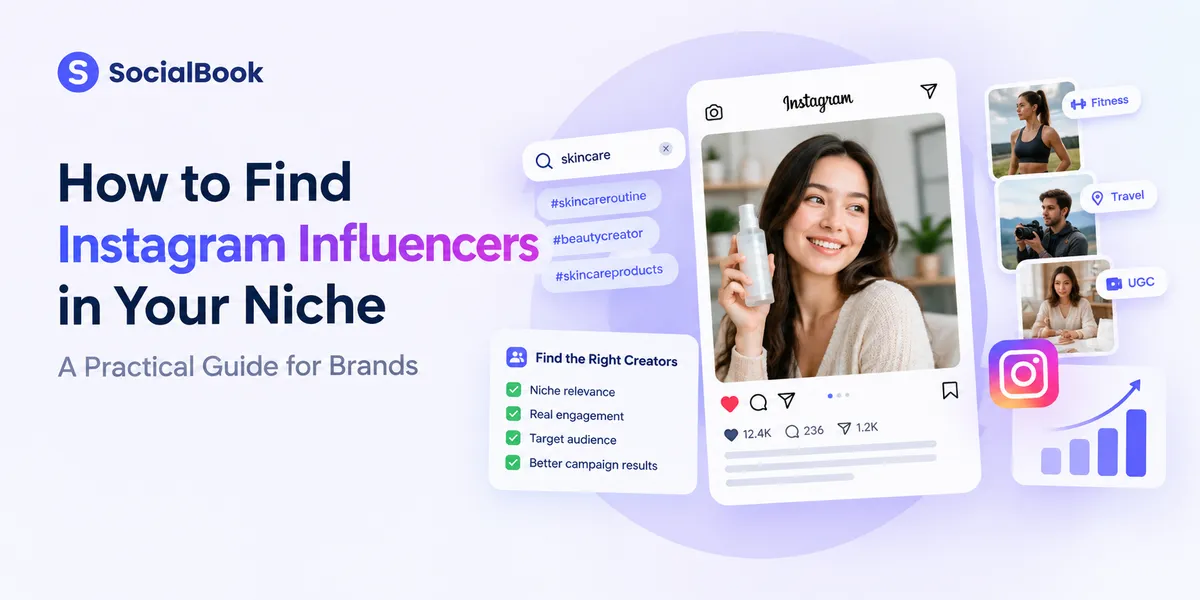
How to Find Instagram Influencers in Your Niche: A Practical Guide for Brands
Finding Instagram influencers is easy. Finding creators who understand your niche, reach the right audience, and can help your brand achieve its marketing goals is a different story.
A creator may have thousands of followers and beautiful content, but that doesn't automatically make them a good fit for your campaign. Their audience might be in the wrong country, their engagement may be inconsistent, or their content style may not match your brand.
The key is to look beyond follower counts and focus on relevance, audience quality, and content performance.
In this guide, we'll walk through practical ways to find Instagram influencers in your niche, evaluate potential partners, and build a shortlist for your next influencer marketing campaign. We'll also explore how SocialBook can help brands streamline creator discovery and make more informed collaboration decisions.
Why Finding the Right Instagram Influencers Matters
Influencer marketing works best when a creator's content, audience, and personal interests naturally align with your product.
For example, a skincare brand might consider beauty influencers an obvious choice. However, a creator who regularly shares skincare routines, ingredient reviews, and product comparisons may be a better partner than a general lifestyle influencer with a larger following.
The same principle applies across industries. Fitness brands can work with workout creators, running communities, and sports nutrition reviewers. Tech brands can explore gadget reviewers, gaming creators, and tech educators.
Before you start searching, define three things:
Your niche: What topics should the creator regularly cover?
Your target audience: Who do you want to reach, and where are they located?
Your campaign goal: Are you trying to build brand awareness, generate engagement, drive sales, or collect user-generated content?
Having clear answers will make it much easier to identify relevant creators and evaluate their potential value.
1. Search Instagram Using Niche Keywords and Hashtags
Instagram's search function is one of the easiest places to start finding influencers. Instead of searching only for the word "influencer," look for the topics, products, and problems your ideal customers care about.
For example, a brand selling home fitness equipment could search for:
Home workout routines
Fitness equipment reviews
Small apartment workouts
Beginner strength training
#HomeWorkout
#FitnessTips
#HomeGym
These searches can reveal creators who consistently publish relevant content, even if they don't describe themselves as influencers in their bios.
Look Beyond the First Search Results
Don't stop after finding a few promising accounts. Explore related hashtags, read captions, and check the creators who appear repeatedly in your niche.
Pay attention to whether a creator regularly covers the topic or has only posted about it once. Consistent content usually provides stronger evidence of genuine interest and an established audience.
You can also search for customer questions and specific product use cases. For instance, a travel accessories brand might discover creators through searches such as "packing tips for long flights" or "carry-on essentials," rather than relying only on "travel influencer."
The more closely your searches reflect real customer interests, the more relevant your results are likely to be.
2. Explore Suggested Accounts and Related Creators
Once you've found an influencer who fits your niche, use their profile as a starting point for further research.
Look at Instagram's suggested accounts, creators they tag, and other influencers they collaborate with. These connections can help you discover people working in similar communities.
For example, if you find a creator who regularly reviews running shoes, you might discover other creators who focus on marathon training, running apparel, recovery routines, or beginner fitness.
You don't always need to target large accounts, either. Smaller creators can offer a closer connection with niche audiences, making them worth considering for product-focused campaigns. If you're working with a limited budget, this guide on how to find micro-influencers for free offers additional ways to discover relevant creators and explore collaboration opportunities.
These adjacent niches can be valuable because they often attract audiences with overlapping interests.
However, don't assume that every recommended account is a suitable partner. Review each creator individually and apply the same criteria you would use for your original search.
3. Find Influencers Through Brand Collaborations and Competitor Research
Your competitors can provide useful clues about which creators are already active in your industry.
Start by reviewing the Instagram accounts of competing brands and complementary businesses. Look at tagged posts, creator mentions, sponsored Reels, and content shared through their official accounts.
Instagram's Paid Partnership label and sponsorship disclosures such as "ad" or "sponsored" can help you identify previous brand collaborations.
For example, a beauty brand could research creators who have worked with skincare companies, makeup brands, beauty retailers, or personal care businesses.
A home appliance brand could look at product reviewers who have collaborated with kitchenware companies, home improvement brands, or smart home businesses.
Evaluate the Content, Not Just the Brand Name
Finding a creator who has worked with a competitor is only the beginning.
Ask yourself:
Does the creator explain the product naturally?
Are viewers asking genuine questions about the product?
Does the content generate meaningful conversations?
Does the creator's audience appear relevant to your target market?
Is there evidence of repeated partnerships or strong product storytelling?
A competitor's collaboration history can help you discover potential partners, but it doesn't guarantee that those creators will deliver strong results for your campaign.
You should also check whether the creator has existing exclusivity agreements or upcoming commitments that could affect a new partnership.
Don't forget your own brand's tagged posts and mentions. Customers or creators who already feature your products may be worth considering for a more formal collaboration.
4. How to Find Local Instagram Influencers
If your brand targets a specific city, region, or country, location matters just as much as niche relevance.
A creator can be popular worldwide without reaching the customers you need. For local businesses, restaurants, retail stores, and region-specific campaigns, audience geography can be especially important.
Start by combining location terms with niche keywords.
For example, a New York fitness studio might search for:
New York fitness influencers
NYC workout creators
Brooklyn wellness bloggers
New York gym reviews
#NYCFitness
You can also explore public posts tagged at local gyms, events, stores, and popular venues to discover creators who regularly cover the area.
Check Where Their Audience Lives
A creator's location does not necessarily tell you where their followers are based.
Someone living in New York might have a mostly international audience, while a creator based elsewhere could regularly publish content for New York residents.
Before committing to a collaboration, ask shortlisted creators for recent audience insights, including top countries and cities where available.
For example, if you're launching a product in the United States, a creator with a relevant U.S. audience may be more valuable than someone with a larger following concentrated in markets you don't serve.
Use location tags as a discovery tool, not as proof of a creator's residence or audience demographics.
5. Use Google to Discover Instagram Influencers
Instagram isn't the only place to search for creators. Google can help you uncover profiles, interviews, creator roundups, and niche content that may not appear in your Instagram search results.
Try combining your niche with a platform-specific search.
For example:
site:instagram.com "skincare routine"site:instagram.com "home workout"site:instagram.com "tech reviews""New York fitness influencer" Instagram
The site:instagram.com operator limits results to indexed pages from Instagram. Quotation marks can help you search for a specific phrase.
You can also search for lists of creators in your industry, such as "best sustainable fashion creators" or "top home decor Instagram accounts."
These articles can provide useful starting points, but don't rely on them alone. Some lists may be outdated, and follower counts or content focus can change over time.
Always visit the original Instagram profile to verify the creator's current activity, recent content, and audience relevance before adding them to your shortlist.
6. Evaluate Influencers Beyond Follower Count
Once you have a list of potential creators, the next step is to determine which ones are worth contacting.
Follower count is useful for understanding potential reach, but it shouldn't be your only selection criterion. A smaller creator with a highly relevant audience and consistent engagement may be a better fit than a much larger account with limited audience overlap.
Review Recent Content and Engagement
Start by reviewing around 10 recent, comparable posts. If your campaign focuses on Reels, prioritize Reels rather than comparing them indiscriminately with static images or other formats.
Record the publication dates, visible likes, comments, and other available performance data.
A simple way to estimate public engagement by followers is:
Engagement rate (%) = (Average likes + Average comments) ÷ Follower count × 100
For example, suppose an Instagram creator has 10,000 followers and averages 300 likes and 50 comments per post.
Their estimated public engagement rate would be:
(300 + 50) ÷ 10,000 × 100 = 3.5%
This calculation is a useful comparison tool, not a guarantee of campaign performance. It doesn't include every type of interaction or measure the percentage of followers who actually saw a post.
Use the same formula and a similar sample of posts when comparing different creators. Also consider the creator's niche, follower size, content format, and how recently the posts were published.
Engagement rate is only one part of the evaluation process. Brands should also consider audience quality, content consistency, reach, and other relevant indicators. For a deeper breakdown, explore the key influencer metrics brands should evaluate before deciding which creators to contact.
Read the Comments Carefully
Numbers can tell you part of the story, but comments often reveal more about the relationship between a creator and their audience.
Look for comments that show genuine interest in the content or product. For a skincare creator, these might include questions about ingredients, product suitability, or how to use a product.
Repeated generic comments, unrelated responses, or giveaway-only interactions deserve a closer look, although none of these patterns alone proves that an account has fake followers.
When something seems unusual, investigate further and request additional performance data before making a decision.
Check Audience Quality and Authenticity
If your goal is to reach a specific customer segment, audience relevance should be a priority.
Where available, review audience locations, age ranges, interests, and other relevant demographic information. You can also examine follower growth and engagement patterns for signs that warrant further investigation.
SocialBook's Instagram Fake Follower Checker and influencer analytics tools can help brands investigate creator profiles beyond surface-level metrics.
Remember that third-party estimates are not the same as verified campaign outcomes. If audience quality is critical to your decision, ask the creator for recent first-party analytics and clarify which metrics are available.
7. Build a Shortlist Before Contacting Creators
Finding potential influencers is only useful if you can compare them and keep track of your decisions.
Create a spreadsheet or use an influencer marketing platform to organize your research.
For each creator, record:
Profile information: Instagram handle, profile link, and follower count.
Niche relevance: Recent posts that demonstrate a strong fit with your product.
Engagement: Average visible likes, comments, and the calculation method used.
Audience fit: Relevant locations, demographics, and interests, where verified.
Collaboration history: Previous sponsored posts and potential conflicts.
Contact details: Public business email or preferred contact method.
Next steps: Outreach status, outstanding questions, and follow-up dates.
Include links to two or three relevant posts so your team can quickly understand why each creator made the list.
You can also expand your search beyond traditional influencers. If your campaign needs authentic product demonstrations, reviews, or lifestyle content, you may want to find and hire UGC creators who can produce content tailored to your brand.
Influencers and UGC creators can serve different purposes, so define whether your priority is audience reach, creator credibility, reusable content, or a combination of these goals.
It's also useful to distinguish between verified information and details that still need confirmation. For example, you might note that a creator regularly publishes fitness content but has not yet provided audience-location data.
This approach makes the selection process more transparent and reduces the risk of choosing creators based on impressions alone.
8. Use SocialBook to Find Instagram Influencers More Efficiently
Manual research works well when you're looking for a handful of creators. But when you're searching across multiple niches, countries, or campaigns, reviewing profiles one by one can become time-consuming.
SocialBook helps brands and agencies streamline influencer discovery with creator search, profile insights, and influencer marketing workflows.
Instead of relying entirely on Instagram searches and spreadsheets, you can use SocialBook to explore a broader pool of potential partners and organize your creator research.
Search for Creators Based on Your Campaign Needs
Start with a clear brief describing your ideal influencer.
For example:
We're looking for Instagram creators who publish skincare reviews, reach beauty-conscious consumers in the United States, and regularly create product-focused content.
Use your campaign requirements to guide the search, including relevant keywords, creator categories, locations, and available performance filters.
SocialBook provides influencer discovery across multiple platforms, including Instagram, TikTok, YouTube, and Twitch. Its broader creator database can help brands explore relevant profiles without relying exclusively on manual searches.
Explore the SocialBook Influencer Search platform to start researching potential partners.
Analyze Creator Profiles Before Making a Decision
After identifying promising creators, review the available profile information and performance indicators to understand how well each one fits your campaign.
Focus on the factors that matter most to your objectives:
Is the creator's content consistently relevant to your niche?
Does their audience align with your target market?
Are their recent posts performing consistently?
Do their previous collaborations match the type of campaign you're planning?
Use these insights to narrow your list and identify which creators require additional verification.
If you're comparing different discovery platforms or looking for ways to make your workflow more efficient, our guide to AI tools for influencer marketing explains how technology can support creator discovery, audience research, and campaign planning.
No search tool can guarantee that a collaboration will succeed. The goal is to make the research process more efficient while keeping the final decision grounded in relevant evidence.
Turn Creator Discovery Into a Repeatable Workflow
Finding influencers is only one part of influencer marketing. Once you've built your shortlist, you still need to contact creators, negotiate deliverables, coordinate content, and evaluate campaign performance.
SocialBook brings creator discovery together with tools for outreach, campaign management, and competitor monitoring, helping marketing teams organize more of this process in one place.
You can also explore competitor influencer activity to discover creators and content approaches that may be relevant to your own strategy.
For brands managing multiple campaigns, a repeatable workflow makes it easier to compare potential partners, avoid duplicate research, and keep track of collaboration progress.
Frequently Asked Questions
How Can I Find Instagram Influencers in My Niche for Free?
Start with Instagram keyword searches, niche hashtags, suggested accounts, public brand collaborations, and location tags. Google can help you discover additional profiles. Review recent content and engagement, then organize your findings in a spreadsheet before contacting creators.
How Do I Find Micro-Influencers on Instagram?
Search for specific topics, customer problems, and niche communities rather than focusing only on broad influencer keywords. Look for smaller creators who publish consistently about your category and have an audience that matches your target market.
Don't assume that a smaller following automatically means better engagement or lower pricing. Evaluate each creator based on content quality, audience relevance, performance, and your campaign goals. You can also read our guide on finding micro-influencers for free for additional discovery ideas.
What Is a Good Engagement Rate for Instagram Influencers?
There is no universal engagement rate that guarantees good results. Engagement varies by niche, follower size, content format, audience characteristics, and calculation method.
Use a consistent formula to compare creators with similar characteristics, and look beyond the percentage to assess comment quality, content relevance, and audience fit. For more evaluation criteria, see our guide to important influencer metrics for brands.
How Can I Tell if an Instagram Influencer Has Fake Followers?
Review multiple signals, including unusual follower growth, inconsistent engagement, and repeated generic or unrelated comments. These patterns can indicate a need for further investigation, but they are not definitive proof.
Where possible, use creator analytics tools and request recent first-party audience data before making a significant investment.
Should I Choose an Influencer With More Followers?
Not necessarily. A larger following can provide greater potential reach, but it doesn't guarantee that the creator reaches your target customers or generates meaningful results.
Choose creators based on the balance of audience relevance, content quality, engagement, budget, and campaign objectives.
How Should I Contact an Instagram Influencer?
Use the creator's listed business email or preferred contact method. Introduce your brand, mention a specific post that demonstrates why you chose them, and explain the proposed collaboration.
Include the expected deliverables and campaign timing, then ask about availability, rates, and relevant audience or performance information.
Can SocialBook Help Me Find Instagram Influencers?
Yes. SocialBook offers influencer discovery and creator analytics tools that help brands research potential partners across major social platforms, including Instagram. You can use its search and available profile insights to build a shortlist, evaluate creator fit, and support your outreach workflow.
Final Thoughts: Find the Right Creators, Not Just More Creators
Finding Instagram influencers in your niche takes more than searching a hashtag and sorting profiles by follower count.
The most effective approach combines targeted keyword research, creator connections, competitor analysis, location checks, engagement evaluation, and audience verification.
Start with a clear campaign brief, review recent content, and build a shortlist that explains why each creator is worth considering. When manual research becomes difficult to manage, use a dedicated discovery platform to make the process more organized and scalable.
With SocialBook, brands can explore relevant creators, review available insights, and build a more structured influencer marketing workflow.
Ready to find creators for your next campaign? Visit SocialBook Influencer Search and start exploring potential partners for your brand.
