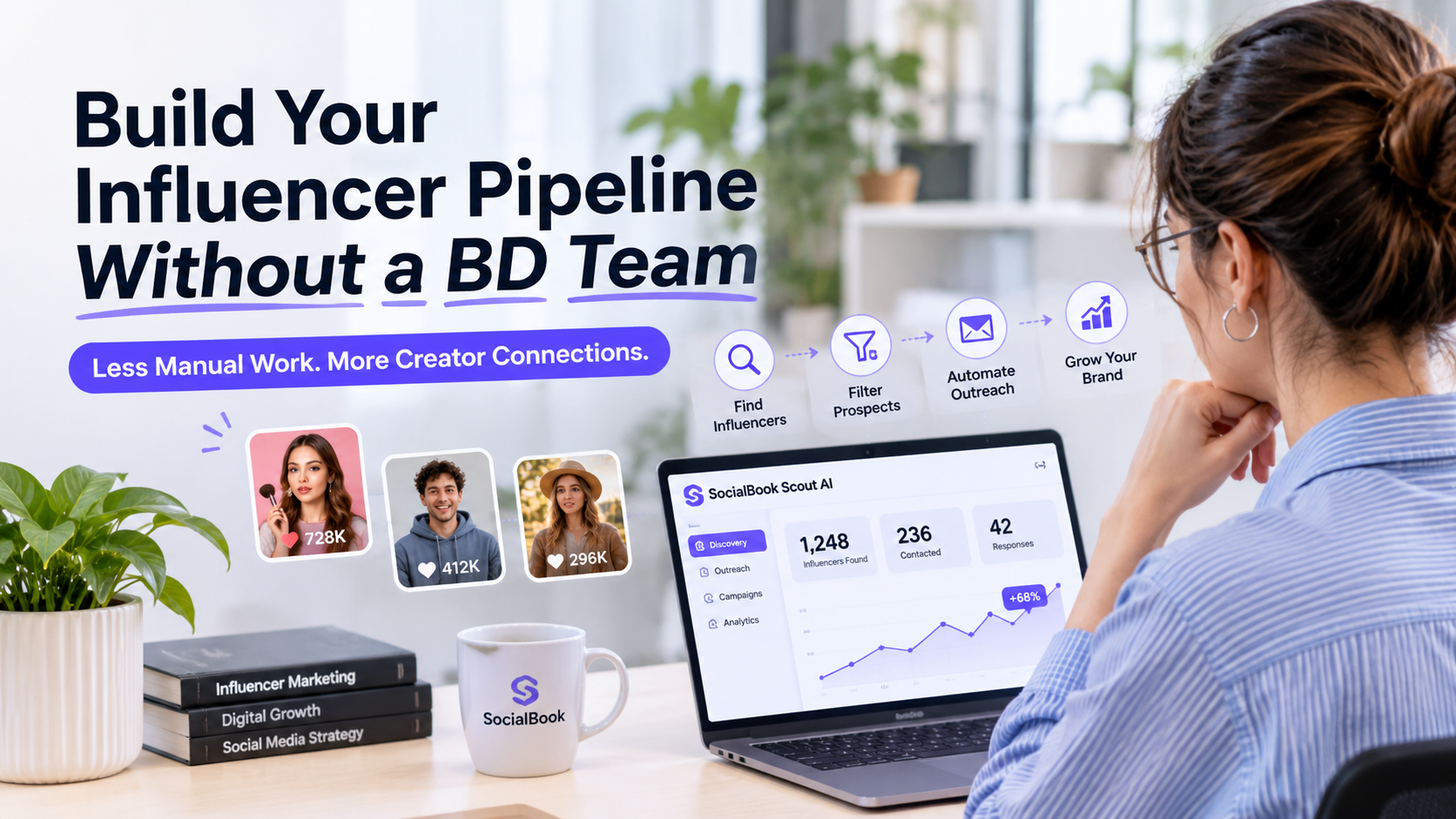
How to Build an Influencer Pipeline Without a Dedicated BD Team
For many growing brands, influencer marketing sounds straightforward: find creators, send collaboration emails, negotiate partnerships, and launch campaigns.
But the reality is very different.
Finding relevant influencers takes time. Researching their content and audiences takes even longer. Then comes the outreach process, which involves writing personalized emails, tracking responses, following up, and managing potential collaborations.
For a small e-commerce brand or startup with only one or two marketing employees, these tasks can quickly become overwhelming.
Hiring a dedicated Business Development (BD) team might seem like the obvious solution, but not every business has the budget or workload to justify additional employees.
The good news? You don't necessarily need a large BD team to build a consistent influencer pipeline.
With a clear workflow and the right AI-powered tools, brands can automate much of the repetitive work involved in influencer discovery and outreach.
In this guide, we'll explain how to build an influencer pipeline without a dedicated BD team, reduce manual work, and create a repeatable system for finding and contacting potential creators.
Why Do Small Brands Struggle With Influencer Pipeline Management?
Before building a more efficient system, it's important to understand why influencer development becomes difficult for smaller teams.
1. Finding the Right Influencers Takes Too Much Time
Influencer discovery is rarely as simple as searching for a popular creator on Instagram or TikTok.
Brands need to find people who create relevant content, reach the right audience, operate in the target market, and have a content style that fits the product.
For example, a brand selling professional makeup tools may need to find beauty educators, makeup artists, and product reviewers rather than general lifestyle influencers.
Manually searching across different platforms, checking individual profiles, and organizing contact information can consume hours every week.
2. Manual Outreach Is Difficult to Scale
Even after finding suitable creators, contacting them creates another workload.
A BD employee may need to research each influencer, understand their content, write a personalized message, locate their business email, and track whether they respond.
When a brand wants to contact 50, 100, or even 500 creators, this process becomes difficult to maintain manually.
Sending generic messages isn't a good alternative either. Creators receive collaboration requests regularly, and irrelevant or poorly written emails are easy to ignore.
3. Small Teams Have Limited Resources
For many startups and growing e-commerce businesses, influencer marketing is only one part of the marketing team's responsibilities.
The same employees may also manage paid advertising, social media, SEO, customer acquisition, and product launches.
Building an influencer pipeline shouldn't require sacrificing time from other important marketing activities.
4. Influencer Research Often Starts From Scratch
Another common problem is the lack of a repeatable discovery process.
When brands need new creators for every campaign, employees often repeat the same research steps. They search similar keywords, revisit the same profiles, and manually look for new opportunities.
Without a systematic approach, influencer prospecting becomes an ongoing administrative task instead of a scalable marketing process.
What Is an Influencer Pipeline?
An influencer pipeline is a structured process for identifying, evaluating, contacting, and managing potential influencer partners.
Instead of searching for creators only when a campaign starts, brands continuously build a pool of potential collaborators.
A basic influencer pipeline can include five stages:
Discovery: Find creators relevant to your products and target audience.
Qualification: Evaluate their content, audience, location, platform, and follower count.
Outreach: Contact potential partners with personalized collaboration emails.
Follow-up: Track responses and continue conversations with interested creators.
Conversion: Move qualified creators into active collaboration opportunities.
The goal isn't simply to collect a large number of influencer profiles. It's to create a consistent flow of relevant prospects that your team can work with over time.
How to Build an Influencer Pipeline Without Hiring a BD Team
Here are six practical steps to establish a repeatable influencer development workflow, even if your business doesn't have dedicated BD employees.
Step 1: Define Your Ideal Influencer Profile
Before searching for creators, determine what kind of influencers your brand actually needs.
Without clear criteria, your team may spend time contacting creators who have large audiences but little relevance to your products.
Start by identifying:
Niche: What topics should creators regularly cover?
Location: Which countries or markets are you targeting?
Social Platform: Do you need TikTok, Instagram, YouTube, or multiple platforms?
Follower Range: Are you targeting micro, mid-tier, or larger influencers?
Content Style: Do you prefer tutorials, product reviews, unboxing videos, or lifestyle content?
For example, an emerging skincare brand targeting the US market might prioritize beauty reviewers and skincare educators on TikTok and YouTube.
A more focused influencer profile makes discovery easier and prevents your outreach efforts from becoming too broad.
Step 2: Use AI to Discover Relevant Influencers Faster
Once you know your ideal creator profile, the next challenge is finding enough relevant influencers.
Instead of manually searching for hundreds of creators, consider using AI-powered influencer discovery.
With SocialBook Scout AI, brands can start by entering their product or website URL.
The AI analyzes the website and generates seven relevant keywords based on the brand and its products. These keywords help identify different creator categories and potential influencer opportunities.
For example, a brand selling home fitness equipment might receive keyword suggestions related to home workouts, fitness equipment, workout routines, and healthy lifestyles.
This gives marketers a more structured starting point for influencer discovery.
You can also explore potential creators through competitor research. Rather than relying only on general keyword searches, Scout AI helps identify competitors and discover influencers associated with those brands.
This is particularly useful for businesses entering competitive markets. Creators who have already worked with similar brands may understand the product category and have audiences interested in related products.
If your business sells products on Amazon, you can also explore our guide on how to automate Amazon influencer outreach to learn more about finding and contacting creators for Amazon products.
Step 3: Filter and Prioritize Your Influencer Prospects
Finding a large number of influencers doesn't automatically create a valuable pipeline.
The next step is narrowing down your prospects.
A small marketing team shouldn't waste time reviewing every creator individually. Instead, establish a few basic qualification criteria.
For example:
Qualification Factor | What to Check |
|---|---|
Location | Is the creator based in your target market? |
Social Platform | Does the creator use your preferred platform? |
Follower Count | Does their audience size fit your campaign? |
Content Niche | Is their content relevant to your product? |
Audience Relevance | Are their viewers likely to be interested in your product? |
Content Quality | Does their content style match your brand? |
SocialBook Scout AI allows brands to filter creators by location, social platform, and follower count, helping narrow down potential prospects before outreach.
You should also prioritize creators based on their relevance rather than follower count alone.
For instance, a cosmetics brand might explore the top makeup YouTubers in 2026 to understand the different types of beauty creators and identify content styles that fit its marketing goals.
A smaller creator with a highly relevant audience may be a better prospect than a much larger creator whose content has little connection to your product.
Step 4: Automate Personalized Influencer Outreach
Once you've built a qualified prospect list, the next challenge is contacting those creators.
This is where small teams often experience the biggest bottleneck.
Writing personalized emails manually for every influencer is time-consuming. But sending the same generic template to everyone can make your brand look unprofessional.
AI-powered outreach offers a more scalable alternative.
SocialBook Scout AI uses AI to help write influencer outreach emails and automate the sending process.
Instead of manually drafting every message, marketers can use AI-generated emails to make the initial outreach process more efficient.
The platform also uses warmed-up email accounts as part of its outreach workflow to support sender reputation and email deliverability.
However, email warm-up alone cannot guarantee inbox placement. Brands should still follow responsible sending practices and maintain proper email authentication.
A good influencer outreach email should include:
A personalized greeting.
A short introduction to your brand.
A specific reason for contacting that creator.
A brief explanation of the product.
A clear collaboration opportunity.
An easy next step.
The objective is to make outreach more efficient without losing the personal touch that makes creator partnerships meaningful.
Step 5: Build a Consistent Outreach Schedule
One of the biggest mistakes small brands make is treating influencer outreach as a one-time campaign.
They might contact a large group of creators before a product launch, stop outreach afterward, and then start the entire discovery process again when the next campaign begins.
A better approach is to maintain a consistent daily or weekly outreach schedule.
For example, a small marketing team could establish a routine like this:
Frequency | Activity |
|---|---|
Daily | Discover and qualify new influencers |
Daily | Send personalized outreach emails |
Weekly | Review responses and identify interested creators |
Weekly | Explore new niches and competitor partnerships |
Monthly | Evaluate outreach performance and refine targeting |
Consistency matters more than sending a huge number of emails in a single day.
With SocialBook Scout AI, brands can set a daily outreach budget and control how many influencers they want to reach.
This allows smaller businesses to start with a manageable level of activity and gradually expand their prospecting efforts as their needs grow.
Step 6: Measure Your Influencer Pipeline Performance
An influencer pipeline should be measured by more than the number of profiles discovered or emails sent.
Your team needs to understand whether the process is generating meaningful opportunities.
Here are some useful metrics to monitor:
1. Influencers Discovered
How many potential creators are added to your prospect pool?
This helps you understand whether your discovery process is producing enough opportunities.
2. Outreach Volume
How many influencers are contacted within a specific period?
Tracking this metric helps measure the consistency of your outreach workflow.
3. Email Response Rate
What percentage of contacted influencers reply?
A low response rate may indicate that your targeting, email personalization, or collaboration offer needs improvement.
4. Positive Response Rate
How many creators express genuine interest in working with your brand?
This metric is often more meaningful than total replies because not every response represents a potential partnership.
5. Collaboration Conversion Rate
How many contacted creators eventually become active partners?
This helps evaluate whether your influencer pipeline is generating real business opportunities.
By reviewing these metrics regularly, even a small marketing team can identify bottlenecks and improve its influencer development strategy.
How SocialBook Scout AI Helps Small Brands Build an Influencer Pipeline
Building an influencer pipeline without a dedicated BD team doesn't mean doing everything manually.
The key is reducing repetitive tasks and creating a workflow that can operate consistently without requiring constant employee involvement.
SocialBook Scout AI is designed to help brands streamline influencer discovery and outreach through an AI-powered workflow.
Here's how it supports the process:
AI Product Analysis
Enter your product or brand website URL, and Scout AI analyzes your business to generate seven relevant influencer discovery keywords.
Competitor Influencer Research
Discover competitors and explore creators associated with competing brands. This gives businesses additional opportunities to identify relevant potential partners.
Creator Filtering
Narrow down potential influencers based on location, social media platform, and follower count.
AI-Powered Email Writing
Generate influencer outreach emails with AI instead of manually writing every message from scratch.
Automated Outreach
Use the automated outreach workflow and warmed-up email accounts to reduce repetitive manual work.
Daily Budget Control
Set a daily outreach budget and manage the number of influencers you want to reach.
By combining these capabilities, Scout AI helps small teams move from manual influencer research to a more structured discovery and outreach workflow.
Instead of spending most of their time searching for creators and writing emails, marketers can focus more on evaluating promising partnerships and managing campaign opportunities.
You Don't Need a Large Team to Build a Strong Influencer Pipeline
A dedicated BD team can certainly help businesses manage large-scale influencer partnerships. But for smaller brands, hiring additional employees isn't always the most practical first step.
What matters more is having a repeatable process.
Define your ideal influencer profile, use AI to discover relevant creators, filter prospects based on your campaign goals, automate repetitive outreach tasks, and regularly review performance.
This approach allows small marketing teams to build and maintain an influencer pipeline without taking on the cost and complexity of a full BD department.
The future of influencer marketing isn't necessarily about having more people doing manual research. It's about helping smaller teams work smarter with better systems and automation.
Ready to build your influencer pipeline without hiring a dedicated BD team?
Try SocialBook Scout AI and simplify how your brand discovers, contacts, and develops relationships with influencers.