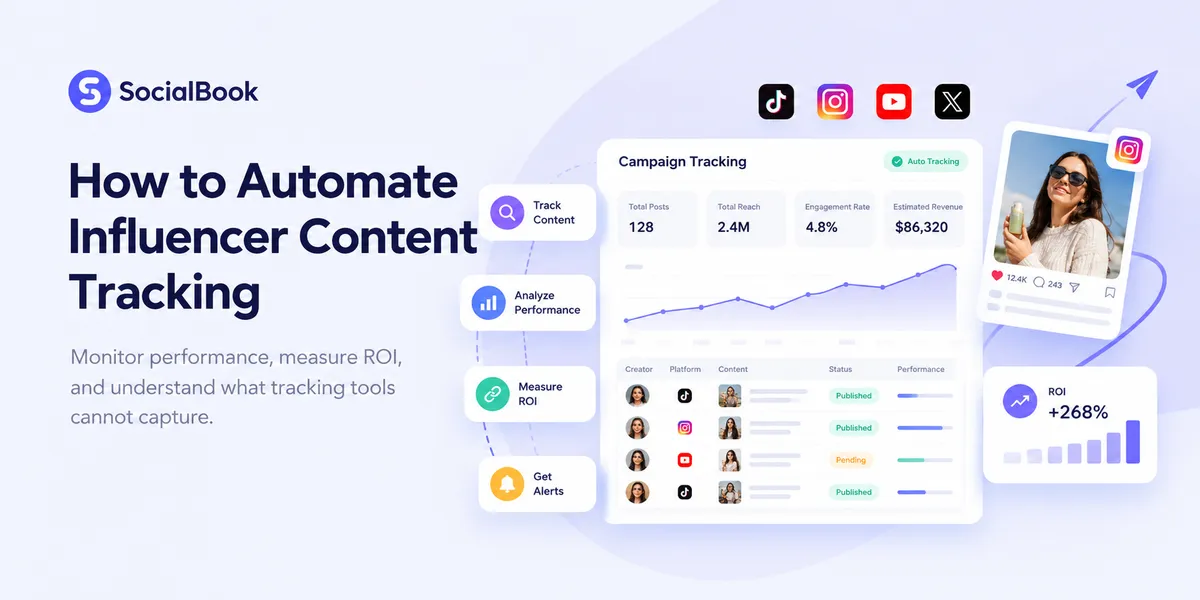
How to Automate Influencer Content Tracking Without Losing Sight of Performance
Influencer marketing can generate hundreds of posts, videos, Stories, and product mentions across multiple social platforms. Keeping track of every creator, checking engagement numbers, and figuring out which collaborations actually deliver results can quickly become a full-time job.
That is where automated influencer content tracking comes in.
With the right workflow, brands can spend less time collecting data and more time understanding what works. But automation has its limits. Public engagement metrics do not reveal every audience insight, and a high-performing post does not automatically translate into sales.
For brands running creator campaigns at scale, the goal is not to automate every decision. It is to build a reliable tracking system that combines consistent data collection, meaningful performance analysis, and human judgment.
Here is how to do it.
What Is Automated Influencer Content Tracking?
Automated influencer content tracking is the process of collecting, organizing, and monitoring creator content and performance data with less manual work.
Instead of opening individual TikTok, Instagram, or YouTube profiles every day, marketers can use tracking tools and structured workflows to monitor published content, review engagement, and organize campaign results in one place.
A typical tracking workflow can help brands:
Monitor new posts from selected creators.
Collect publicly available engagement metrics.
Identify sponsored content and brand mentions.
Compare creator performance across a campaign.
Track traffic and conversions through campaign-specific links.
Flag missing deliverables and posts that need attention.
Build reports without manually compiling every metric.
The most important distinction is between collecting data and interpreting it. Automation makes the first process faster, but marketers still need to decide which numbers matter and what actions to take.
1. Decide What You Need to Track Before Automating
The easiest way to build an ineffective tracking system is to collect every available metric without defining a goal.
Before choosing a tool, decide what success looks like for your campaign. A campaign designed to increase brand awareness requires a different measurement approach from one focused on direct sales.
Brand awareness campaigns
If your goal is to introduce a product to a new audience, prioritize:
Video views and publicly available impressions.
Reach, when available from authorized analytics.
Engagement volume and engagement rate.
Brand mentions and the number of creator posts published.
Performance across different content formats.
These metrics help you understand how widely your campaign is being seen and which creators are generating attention.
Keep in mind that views, impressions, and reach are not interchangeable. Each platform defines and reports these metrics differently, so comparisons should account for those differences.
Engagement and community-building campaigns
If your objective is to encourage people to interact with your brand, pay closer attention to comments, shares, saves where available, and the quality of audience responses.
A post with fewer views can still be valuable if it generates relevant questions, product discussions, or genuine recommendations.
Automated reporting can surface engagement patterns, but reviewing a sample of comments and posts helps explain why those patterns exist.
Sales and conversion campaigns
For campaigns designed to generate revenue, focus on measurable actions such as link clicks, product-page visits, add-to-cart events, purchases, and revenue attributed to each creator.
This is where content tracking needs to connect with website analytics, affiliate reporting, or ecommerce data.
SocialBook's existing guide, How to Track Your Influencer Marketing Campaigns to Yield the Best ROI, explains how brands can align campaign objectives with the right performance indicators.
The key principle is simple: choose your KPIs first, then automate the collection of data that helps you evaluate them.
2. Centralize Creator Content Instead of Checking Every Profile Manually
When a campaign involves multiple creators, platforms, and publishing dates, manual monitoring becomes difficult to maintain.
A centralized tracking workflow gives your team a consistent way to review creator activity without switching between dozens of browser tabs.
Start by creating a master list containing each creator's name, social profile, platform, campaign, expected deliverables, publishing deadline, and agreed tracking method.
Then organize published content by creator and campaign. Each post should ideally include its URL, publication date, content format, available performance metrics, and the date the data was collected.
This structure makes it easier to answer practical questions:
Which creators have published their content?
Which deliverables are still outstanding?
Which posts are generating the strongest engagement?
Are some creators outperforming their usual results?
Which campaigns need follow-up or additional support?
A dedicated influencer marketing platform can reduce the time spent collecting and organizing this information. However, its coverage depends on supported platforms, available data, and the way content is identified.
If you are still building your creator roster, start with SocialBook's influencer search engine to discover potential partners and organize your selection process before launching a tracking workflow.
Better tracking starts with better organization. When creator information and campaign requirements are consistent, reporting becomes easier to maintain and less prone to errors.
3. Use Multiple Signals to Catch More Campaign Content
One of the most common tracking problems is missing content that was actually published.
A creator might forget a campaign hashtag, mention a product without tagging the brand, or publish through a secondary account. If your system depends on a single hashtag, these posts can disappear from your report.
A more reliable workflow uses several identification signals.
Campaign hashtags
Provide creators with a clear, campaign-specific hashtag when it fits the platform and content strategy. It can help identify related posts, particularly when many creators are participating in the same activation.
However, hashtags should not be your only tracking method. Not every creator uses them consistently, and some platforms or content formats offer limited discoverability.
Brand tags and product mentions
Monitor brand account tags, product names, campaign phrases, and other relevant keywords where supported.
These signals can help identify content that does not include the expected hashtag. They are particularly useful when creators naturally mention a product rather than following a rigid caption template.
Direct post URLs
Ask creators to submit their published URLs as part of the campaign deliverables. This provides a straightforward way to confirm publication and connect a specific piece of content with the right creator and campaign.
For contracted deliverables, this step is especially valuable because it gives both sides a clear record of what was published.
Manual verification
Even a well-designed automated system needs a fallback process. Review flagged posts, investigate missing deliverables, and manually add verified URLs when your tools allow it.
The goal is not to eliminate every manual task. It is to reserve human attention for the exceptions that automated systems are most likely to miss.
4. Track Performance Changes, Not Just Final Numbers
A creator's follower count does not tell you how a specific post will perform. Likewise, a single engagement total rarely provides enough context to determine whether a campaign is succeeding.
Automated tracking becomes more useful when you compare results over time.
For example, evaluate a new sponsored video against the creator's recent content rather than relying exclusively on a broad industry benchmark. A post generating 30,000 views might be outstanding for one creator and below expectations for another.
Useful comparisons include:
A creator's current post versus their recent median performance.
Different content formats published by the same creator.
Sponsored content versus comparable organic posts, where the data is available.
Performance across creators working on the same campaign.
Results from the current campaign versus previous collaborations.
Looking at historical performance also helps identify repeatable creative patterns. Perhaps product demonstrations consistently outperform unboxing videos, or short comparison videos attract more meaningful comments than lifestyle content.
These findings can inform your next creative brief and help your team decide which formats deserve further testing.
For a deeper understanding of how to evaluate creators before committing a budget, see SocialBook's guide to checking fake Instagram followers. Assessing audience authenticity alongside content performance gives brands a more complete view of potential partners.
Remember that historical results are a reference point, not a guarantee. Audience interests, creative quality, seasonality, and distribution can all change between campaigns.
5. Connect Content Tracking With Website Traffic and Sales
Content engagement is only part of the picture when your campaign is designed to drive business results.
A video can generate thousands of views without producing meaningful traffic. Another post might attract a smaller audience but send highly motivated shoppers to your product page.
To understand the difference, connect your creator content records with website analytics and conversion data.
Give each creator a unique tracking link
Use UTM parameters to identify the source of incoming traffic. For example, a brand could create a link like this:
https://example.com/products/item?utm_source=instagram&utm_medium=influencer&utm_campaign=fall_launch&utm_content=creator_a
In this example, the parameters identify Instagram as the source, influencer marketing as the medium, the fall launch as the campaign, and a specific creator as the content identifier.
Create consistent naming rules and assign unique links to individual creators whenever possible. Otherwise, your reports may combine traffic from several partners and make it difficult to compare their contributions.
Monitor what happens after the click
Use a website analytics platform such as Google Analytics 4 to examine sessions, landing pages, engagement, and conversions associated with tracked traffic.
For ecommerce campaigns, connect these visits to purchases and revenue wherever your analytics setup supports the connection.
You can then compare the complete journey rather than judging creators solely by views or likes.
Add promo codes and affiliate data
Unique discount codes can provide another way to associate purchases with creator partnerships. Affiliate platforms may also offer order-level information, commissions, and other conversion data.
No attribution method captures every influence on a customer's decision. Someone may discover a product through TikTok, research it later through Google, and finally purchase after seeing an Instagram post.
For this reason, combine available evidence instead of treating one tracking link or last-click report as a complete explanation of campaign performance.
If your program depends heavily on creator-driven purchases, SocialBook's article on influencer affiliate marketing provides additional context on turning creator partnerships into measurable revenue opportunities.
6. Understand What Automated Tracking Cannot See
Automation can make public content easier to monitor, but it cannot remove platform data restrictions or provide access to information that creators have not shared.
Understanding these limits is essential for producing accurate reports.
Private audience analytics
Public posts may expose metrics such as views, likes, or comments, depending on the platform and content type. More detailed information, including audience demographics, private reach data, saves, and certain traffic metrics, may only be available through the creator's authorized analytics.
Do not assume that a tracking tool can retrieve every metric simply because it can identify a post.
When these numbers are important to campaign evaluation, request the relevant analytics from the creator and agree on a reporting deadline before publication.
Instagram Stories and other short-lived content
Stories and similar ephemeral formats can be harder to measure than permanent posts. The metrics available depend on the platform, account permissions, and the timing of data collection.
If Story interactions or link clicks are contractual requirements, ask creators to provide screenshots or authorized reporting promptly after publication. Specify which metrics you need and when they should be submitted.
This avoids relying on data that your tracking system may never be able to access.
Deleted or inaccessible posts
If a creator deletes a post, makes an account private, or changes access settings, a tracking system may no longer be able to retrieve the original content.
Where permitted, retain the published URL, publication confirmation, and relevant performance records while the content is available. For important contractual deliverables, establish an archiving process that respects platform rules and applicable privacy requirements.
Competitor campaign conversions
Public monitoring can help you identify competitors' creator partnerships, publishing activity, engagement patterns, and visible campaign messages.
It generally cannot reveal their private link clicks, actual conversion rates, customer acquisition costs, or verified revenue.
If you are analyzing competitors, distinguish observable evidence from estimates. A popular post may indicate strong attention, but it does not prove that the campaign was profitable.
7. Turn Tracking Into Action With Alerts and Regular Reviews
A dashboard is useful only when someone uses the information to make a decision.
Rather than sending notifications for every metric change, create a small set of alerts that help your team respond to important events.
New content published: Notify the campaign owner when a creator's post goes live. This allows the team to check the deliverable, engage with the content, and consider additional amplification while the post is still receiving attention.
Missing deliverables: Flag creators whose agreed publishing deadlines have passed without a verified post. This gives the team time to follow up before the campaign closes.
Unusually strong performance: Identify posts that significantly outperform a creator's normal results. Review the content to understand what may be working and whether it is suitable for paid amplification or further testing.
Unexpected performance declines: Investigate posts that fall well below expectations. Check the creative, timing, audience relevance, and available engagement signals before assuming the creator is responsible.
Pair these alerts with a regular review schedule. A weekly review is often sufficient for ongoing campaigns, while time-sensitive launches may need more frequent checks.
The purpose of alerts is to shorten the time between discovering a problem and taking action, not to generate more notifications for the team to ignore.
8. Use AI to Analyze Results, Not Invent Missing Data
AI can make influencer reporting more efficient by summarizing campaign results, comparing content formats, identifying recurring themes in comments, and highlighting unusual performance patterns.
For example, once your tracking data has been collected and verified, you can ask an AI assistant to:
Summarize the top-performing posts from the past seven days.
Compare engagement across different content formats.
Identify creators with missing deliverables.
Group posts by product benefit, audience question, or creative angle.
Flag results that differ significantly from historical performance.
Draft a weekly report for the marketing team.
However, AI analysis is only as reliable as the information provided. Missing posts, inconsistent naming conventions, incomplete conversion data, and inaccurate assumptions can all produce misleading conclusions.
Always verify the underlying records before using AI-generated insights to make budget decisions.
SocialBook's guide to AI tools for influencer marketing explores how AI-powered workflows can support creator discovery, analysis, and campaign management. The most effective approach combines automated data collection with human review of the insights that matter.
A Practical Influencer Content Tracking Workflow
For teams that want to implement a repeatable process, the following workflow provides a useful starting point.
Before the campaign: Define objectives and KPIs, select creators, establish deliverables, prepare tracking links, and specify how creators should report content and private metrics.
When content goes live: Collect post URLs, verify that the deliverables meet campaign requirements, capture available public metrics, and record publication dates.
During the campaign: Monitor performance changes, review missing posts, check traffic and conversion data, and investigate content that significantly outperforms or underperforms expectations.
At the end of the campaign: Reconcile deliverables, consolidate creator-level results, evaluate attribution limitations, calculate ROI where reliable cost and revenue data are available, and document lessons for future campaigns.
A useful report should distinguish between confirmed metrics, unavailable data, and estimates. This makes the findings easier to interpret and prevents incomplete information from being mistaken for a poor result.
Frequently Asked Questions
Can influencer content tracking be automated?
Yes. Many parts of the process can be automated, including monitoring selected creators, collecting supported public metrics, organizing post URLs, and preparing performance reports. The level of automation depends on the platform, available data, and tracking tool.
Can you track influencer posts without contacting creators?
Public posts and their available engagement metrics can often be monitored without direct creator involvement. Private analytics, including certain reach, audience, and Story metrics, generally require creator cooperation or authorized access.
How do you track influencer content if a creator forgets the campaign hashtag?
Use several signals where supported, including brand tags, product keywords, and direct post URLs. Ask creators to submit their live content links and verify campaign deliverables instead of relying on a hashtag alone.
How can brands measure influencer campaign ROI?
Compare attributable campaign revenue with the total campaign cost using a consistent calculation:
ROI = (Attributed Revenue − Campaign Cost) ÷ Campaign Cost × 100%
Include relevant expenses, such as creator fees, product costs, commissions, and paid amplification, according to your reporting method. Clearly document how revenue is attributed, since different attribution models can produce different results.
What is the biggest limitation of automated influencer tracking?
The biggest limitation is incomplete visibility. Tools cannot automatically reveal every private metric, recover all deleted content, or prove the revenue impact of another brand's campaign using public engagement data alone. Reliable reporting requires data collection, creator cooperation where needed, and human judgment.
Final Thoughts
Automated influencer content tracking helps brands move beyond scattered screenshots and manual spreadsheets. It creates a more consistent way to monitor publishing activity, compare creator performance, identify missing deliverables, and connect content with measurable business outcomes.
But automation should not be confused with complete visibility.
Public engagement is not the same as reach. Clicks are not the same as purchases. And a post with impressive numbers is not necessarily the most valuable partnership for your brand.
The strongest workflow combines automated tracking, reliable attribution, creator communication, and thoughtful performance analysis.
With SocialBook, brands can bring creator discovery, audience evaluation, and campaign planning into a more organized workflow. Start with the right creators, define what success means, and build a tracking process that turns campaign data into better marketing decisions.
