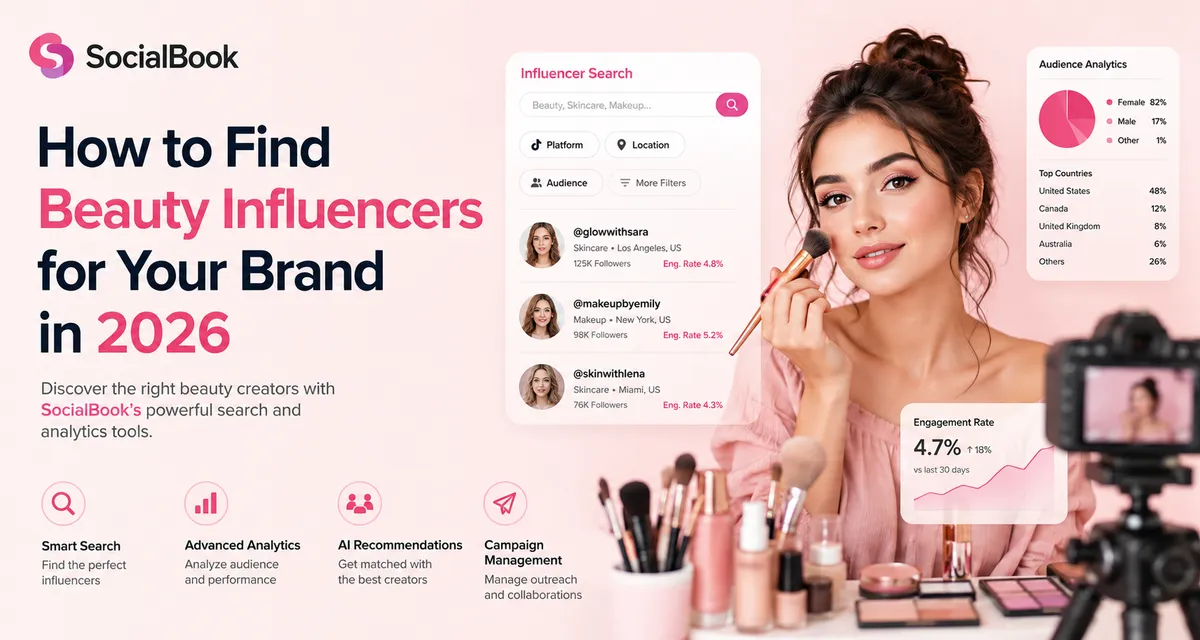
How to Find Beauty Influencers for Your Brand in 2026
Finding the right beauty influencer can make or break an influencer marketing campaign.
The beauty industry is crowded with creators covering everything from skincare and makeup to haircare, fragrance, nails, and beauty UGC. But having a large following doesn't necessarily mean a creator is the right fit for your brand.
The real challenge is finding influencers who have the right audience, content style, engagement, location, and pricing for your campaign.
In this guide, we'll show you how to find beauty influencers in 2026, how to evaluate them, and how SocialBook can help you discover and analyze the right creators faster.
Key Takeaways
- The best beauty influencer isn't necessarily the one with the most followers. Audience relevance and engagement matter more than follower count alone.
- Beauty brands should search by specific niches such as skincare, makeup, haircare, fragrance, or beauty UGC instead of using only the broad "beauty" category.
- SocialBook lets brands search influencers across major platforms using content categories, audience demographics, location, engagement, followers, and other criteria.
- Before contacting a creator, check their audience, recent content, engagement, estimated pricing, and previous brand collaborations.
- A small group of highly relevant micro-influencers can often provide more useful campaign data than relying on one large creator.
Why Beauty Brands Need the Right Influencers
Beauty is one of the most influencer-driven industries.
Consumers don't just want to see a product sitting on a shelf. They want to see:
- How a product looks on real skin
- How makeup is applied
- Whether a skincare routine actually makes sense
- How a product works for different skin types
- What a creator genuinely thinks about the product
- How a product compares with competing brands
That's why beauty influencers can be particularly valuable for product discovery and education.
But there's an important distinction:
A popular beauty creator isn't automatically the right beauty creator for your brand.
For example, imagine you're launching a premium anti-aging skincare product.
A 2-million-follower makeup creator may generate plenty of views, but a 50,000-follower skincare creator whose audience is primarily women aged 25–44 may be much more relevant.
The goal isn't simply to find more followers.
The goal is to find more relevant potential customers.
1. Define Your Beauty Influencer Target First
Before opening an influencer search tool, define exactly what type of creator you're looking for.
"Beauty influencer" is too broad.
You should narrow your search based on your product.
Skincare
Look for creators who regularly create:
- Skincare routines
- Product reviews
- Acne-focused content
- Anti-aging content
- Sensitive-skin content
- Korean skincare content
- Skincare education
Makeup
Consider:
- Makeup tutorials
- GRWM creators
- Beauty reviews
- Drugstore makeup
- Luxury makeup
- Makeup transformations
- Professional makeup artists
Haircare
Search for:
- Curly hair creators
- Hair tutorials
- Hair product reviews
- Hair transformations
- Protective hairstyles
- Hair styling
Fragrance
You can look for:
- Fragrance reviewers
- Perfume creators
- Luxury lifestyle creators
- Fragrance collectors
- "Perfume of the day" creators
Beauty UGC
If your primary goal is creating advertising content rather than reaching the creator's audience, consider UGC creators.
For example, you may want:
- Product demonstrations
- Unboxing videos
- Before-and-after content
- Testimonial videos
- TikTok-style product videos
- Paid social ad creatives
The more specific your target is, the easier it becomes to find the right influencer.
2. Choose the Right Social Platform
Beauty influencers aren't distributed evenly across social media.
Different platforms can be useful for different campaign objectives.
TikTok
TikTok is particularly useful for:
- Product discovery
- Beauty trends
- Tutorials
- Short-form reviews
- Viral product content
- UGC-style videos
Instagram is useful for:
- Beauty photography
- Reels
- Tutorials
- Product launches
- Lifestyle content
- Brand collaborations
YouTube
YouTube can be especially valuable for:
- Detailed product reviews
- Tutorials
- Skincare routines
- Product comparisons
- Long-form educational content
SocialBook supports influencer discovery across platforms including YouTube, Instagram, TikTok, and Twitch, allowing brands to search for creators based on their specific campaign requirements.
Start searching for influencers with SocialBook
3. Use SocialBook to Search for Beauty Influencers
One of the easiest ways to speed up influencer discovery is to use a dedicated influencer search platform.
With SocialBook, brands can search its creator database using keywords, usernames, social URLs, categories, and advanced filters.
Instead of manually opening hundreds of TikTok or Instagram profiles, you can start with a much more targeted search.
For example, a skincare brand could search for:
Beauty → Skincare → United States → Female → 25–44 audience
You can then further narrow the results based on performance and audience characteristics.
This changes the process from:
Search → Open profile → Check followers → Check comments → Repeat
into:
Define criteria → Filter creators → Analyze shortlisted influencers → Contact the best matches
That can save a significant amount of time when you're sourcing creators at scale.
4. Don't Search Only by Follower Count
Follower count is one of the easiest metrics to understand—and one of the easiest metrics to overvalue.
Consider these two creators:
| Creator | Followers | Engagement | Audience Fit |
|---|---|---|---|
| Creator A | 800K | Low | Medium |
| Creator B | 65K | High | Very High |
If Creator B's audience closely matches your target customers, they may be the better choice.
A good influencer evaluation should consider:
- Followers
- Engagement rate
- Average views
- Audience demographics
- Audience location
- Content category
- Recent activity
- Estimated collaboration price
- Previous brand collaborations
SocialBook provides search and sorting options that allow brands to evaluate influencers using metrics such as follower count, average views, engagement rate, influence score, activity, and estimated price.
5. Analyze the Influencer's Audience
This is one of the most important steps in beauty influencer marketing.
You aren't buying followers.
You're buying access to an audience.
For a beauty campaign, look at:
Age
Does the creator reach the demographic that buys your product?
For example:
- Teen beauty → younger audiences
- Anti-aging skincare → 25–44+
- Luxury beauty → potentially higher-income lifestyle audiences
- Professional cosmetics → makeup artists and beauty professionals
Gender
Depending on your product, audience gender can also affect campaign performance.
Location
If you're selling primarily in the United States, an influencer with millions of followers but very little U.S. audience may not be useful.
SocialBook allows brands to filter and analyze audience demographics including age, gender, and country or region.
This is especially useful for brands entering new markets.
6. Check Engagement and Recent Performance
A creator's total follower count tells you very little about what they're capable of doing today.
Instead, look at recent performance.
Important metrics include:
- Average views
- Engagement rate
- Likes
- Comments
- Recent posting activity
- Content consistency
For example, if a beauty creator has 300,000 followers but their recent videos consistently receive only a few thousand views, you should investigate further before spending your campaign budget.
On the other hand, a creator with 40,000 followers consistently generating strong views and meaningful comments may deserve a closer look.
SocialBook's search tools include recent engagement and average-view filters, helping brands prioritize creators based on current performance rather than follower count alone.
7. Look at the Creator's Actual Content
Numbers are only part of the evaluation.
You also need to watch the creator's content.
Ask yourself:
Does this creator naturally talk about products like mine?
For a skincare brand, look for creators who:
- Explain products clearly
- Demonstrate how products are used
- Create skincare routines
- Answer audience questions
- Give detailed reviews
- Have experience with similar products
For makeup brands, look for creators whose content includes:
- Tutorials
- GRWM videos
- Product testing
- Makeup transformations
- Shade comparisons
- Beauty routines
The creator should make your product feel like a natural recommendation, rather than an advertisement inserted into unrelated content.
8. Check Previous Brand Collaborations
A creator's previous partnerships can reveal a lot.
Look for:
- Which beauty brands have worked with them?
- Are they working with competing brands?
- What type of sponsored content do they create?
- Does their sponsored content generate engagement?
- Do they repeatedly work with the same brands?
If a creator has already collaborated with several brands in your category, they may understand how to communicate similar products effectively.
But also watch out for over-commercialization.
If almost every recent post is sponsored, their audience may be less responsive to another promotional message.
9. Consider Micro and Nano Beauty Influencers
Don't automatically focus on celebrity influencers.
Micro and nano influencers can be extremely useful for beauty campaigns.
Smaller creators often have:
- More focused audiences
- Stronger community relationships
- More specific niches
- More accessible collaboration costs
- Greater flexibility
- More opportunities for long-term partnerships
For example, instead of spending your entire budget on one large beauty creator, you could test:
10 × micro influencers
with different audiences and content styles.
Then compare:
- Views
- Engagement
- Clicks
- Sales
- Content quality
- Cost per result
This gives you more data and helps identify which creator profiles actually work for your product.
10. Use SocialBook's AI-Powered Influencer Discovery
Manually searching thousands of creators can still take time.
That's where AI-powered influencer discovery can become useful.
SocialBook's current platform includes AI-Picked Influencers and an AI Product Diagnosis feature designed to analyze product and competitor information and recommend influencers based on marketing requirements.
For example, instead of starting with:
"I need beauty influencers."
You can define a more specific campaign:
"We're launching a premium skincare product in the U.S. and want TikTok creators with an audience interested in skincare."
The more context you provide, the easier it becomes to move from a broad creator database toward a more relevant shortlist.
11. Compare Influencers Before Contacting Them
Don't contact the first 20 influencers you find.
Create a shortlist first.
A useful beauty influencer shortlist might include:
| Criteria | What to Check |
|---|---|
| Niche | Skincare, makeup, haircare, etc. |
| Platform | TikTok, Instagram, YouTube |
| Followers | Audience scale |
| Engagement | Audience interaction |
| Average Views | Recent content performance |
| Audience | Age, gender, location |
| Content | Quality and relevance |
| Price | Estimated collaboration cost |
| Brand Fit | Previous partnerships |
| Contact | Email/social contact availability |
SocialBook allows brands to add influencers to lists, making it easier to organize and compare potential creators during the sourcing process.
12. Contact Beauty Influencers at Scale
Once you've identified the right creators, the next challenge is outreach.
Sending individual messages manually can become difficult when you're working with dozens or hundreds of creators.
A better workflow is:
Search → Shortlist → Analyze → Organize → Outreach → Collaborate → Track
SocialBook is designed to support this broader workflow rather than only influencer discovery. Its influencer marketing tools include creator search, contact and collaboration features, campaign management, and email outreach.
This means brands can move from finding influencers to actually managing relationships within the same workflow.
13. Start With a Small Beauty Influencer Test
You don't need to spend your entire influencer marketing budget on the first campaign.
Start with a test.
For example:
Campaign Goal
Generate sales for a new skincare product.
Platform
TikTok.
Creators
10–20 relevant micro-influencers.
Deliverable
1 short-form product video.
Tracking
Give each creator a unique:
- Discount code
- Affiliate link
- Landing page
- UTM link
Then compare the results.
You can evaluate:
Cost per view
Cost per engagement
Click-through rate
Conversion rate
Revenue
Content quality
The goal of the first campaign isn't necessarily to find the biggest influencer.
It's to discover which creator profile produces the best results for your brand.
14. Repurpose the Best Beauty Influencer Content
Influencer marketing shouldn't end when a creator posts their video.
If you have the appropriate usage rights, high-performing creator content can potentially be repurposed into:
- TikTok videos
- Instagram Reels
- Paid ads
- Product pages
- Landing pages
- Email marketing
- Amazon product listings
- Social media posts
This is another reason why evaluating content quality is just as important as evaluating reach.
A creator who produces one excellent video that can be reused across multiple marketing channels may deliver more value than a creator who simply generates a large number of impressions.
Common Mistakes When Finding Beauty Influencers
Mistake #1: Choosing the influencer with the most followers
More followers don't automatically mean better results.
Always check audience relevance and recent performance.
Mistake #2: Searching only for "beauty"
Beauty is an enormous category.
Break it down into specific niches such as skincare, makeup, haircare, fragrance, nails, or UGC.
Mistake #3: Ignoring audience location
If your customers are primarily in the U.S., make sure the creator actually reaches a meaningful U.S. audience.
Mistake #4: Looking at engagement only once
Influencer performance changes.
Check recent content instead of relying on an old screenshot or historical metric.
Mistake #5: Ignoring sponsored content
Look at how the creator's previous sponsored posts performed.
Mistake #6: Spending everything on one creator
Testing several relevant creators can provide more useful campaign insights.
Mistake #7: Forgetting usage rights
If you want to use influencer content in paid advertising or on your website, clarify usage rights before the campaign starts.
Find the Right Beauty Influencers With SocialBook
Finding beauty influencers doesn't have to mean spending hours scrolling through TikTok and Instagram.
The key is to build a structured discovery process:
1. Define your beauty niche
2. Choose your target platform
3. Set your audience requirements
4. Search for relevant creators
5. Filter by followers, engagement, views, location, and audience demographics
6. Analyze shortlisted influencers
7. Compare potential creators
8. Contact the best matches
9. Run a small test campaign
10. Scale the creators that perform
SocialBook brings these steps together in one influencer marketing platform. Brands can search creators, use advanced filters, analyze influencer and audience data, organize creator lists, and manage influencer campaigns.
Whether you're launching a skincare brand, promoting a new makeup product, looking for beauty UGC creators, or expanding into a new market, the goal remains the same:
Don't just find beauty influencers. Find the beauty influencers whose audience is most likely to become your customers.
Find Beauty Influencers with SocialBook
Frequently Asked Questions
How do I find beauty influencers for my brand?
You can find beauty influencers through social media platforms, influencer marketplaces, influencer agencies, or dedicated influencer discovery tools such as SocialBook. The most effective approach is to search based on niche, platform, audience demographics, engagement, location, and content performance rather than follower count alone.
What should I look for in a beauty influencer?
Look at their niche, audience demographics, engagement rate, average views, content quality, recent activity, previous brand collaborations, estimated pricing, and overall fit with your brand.
How many followers should a beauty influencer have?
There is no universal ideal follower count. Nano and micro influencers can be effective for niche beauty campaigns, while larger creators can provide greater reach. The right choice depends on your campaign objective and budget.
Is TikTok or Instagram better for beauty influencer marketing?
Both can work well. TikTok is particularly useful for short-form product discovery and viral beauty content, while Instagram can be effective for Reels, product launches, tutorials, and visual brand content. The best platform depends on where your target customers spend their time.
How can I check a beauty influencer's audience?
Use influencer analytics tools to evaluate audience age, gender, location, engagement, and other available demographic data. SocialBook provides audience demographic filters that can help brands identify creators who reach their target customers.
How can SocialBook help me find beauty influencers?
SocialBook allows brands to search and filter creators by platform, content category, audience demographics, followers, engagement, views, location, and other criteria. Its current platform also includes AI-powered influencer recommendations and tools for managing influencer campaigns.
